Wednesday, March 27, 2013

In praise of ETA: An heirloom workhorse

While I was still fiddling with fake Rolexes and Breitlings back in junior high, I repeatedly stumbled upon an ugly, old watch that didn't run. It said "Klaiber Automatic - 17 Jewels Waterproof Incalboc - Swiss Made" on the dial. This was a few years ago before I knew much about any type of watch. Last year, while visiting home, I dug out the watch and learned that it was my grandfather's "getting-into-college" gift for my dad from 1982, and that it had been lying in the storage room for at least 20 years. I gave it a few winds and shakes and it didn't seem to work, so I opened the case back and immediately was greeted by a whirling noise (presumably the mainspring unwinding). With the back open, I gave it a few more winds and to my surprise, after 30 years, it ran again.


To my surprise, there was no visible corrosion in the movement which was good enough for me. The rubber gaskets had completely disintegrated and stuck onto the case and caseback and the nickel plating on the brass case had worn off significantly. The spring bars had also failed and the shoddy bracelet was very loose. To my delight, the unmodified and bare ETA 2789 movement (ancestor of the ubiquitous 2824) was the higher 25 jewel version instead of the 17 jewel as indicated on the dial. The lume even still glowed, albeit very weakly.


ETA 2789

25 Jewels!


 First thing the next day I braved the Beijing cold and searched for a watchmaker who would service the movement. The first two turned me down outright, saying "it couldn't be done", which was ludicrous since over 25 million of the movement had been made and spare parts would be easy to find. The third told me it would take 2 months, much too long since I was coming back to the US. Finally I found a shop with two southern Chinese watchmakers who would service the movement and replace the deteriorated crown for 120 dollars. "Are you in a hurry?" he asked with a thick southern accent. "Kind of, what do you mean?" I asked, slightly confused. "Well, if you're in a hurry come on Monday (in 2 days), if not, come on Tuesday." I quickly said "I'll come tuesday after work", took the receipt, and left. 


No corrosion anywhere


On Tuesday, I picked up the watch which was running strong as it did some 30 years ago. With some self adjustment I managed to get it to better than COSC (or even Patek Philippe seal) performance with a 260 degree amplitude. A new leather strap gave the watch that funky retro look.


Superb performance!


Brass base metal showing through nickel plating, case back is stainless steel


To think that my grandfather had spent what was at least several months wage on this watch is more than intriguing for me. Not only was this the dark ages of mechanical horology, it was the dark ages of China, when foreign goods could only be bought in a special store or while traveling abroad (an extremely rare phenomena at the time). I may not have been passed down a Patek or Vacheron, but thinking in context, this was arguably rarer in China than Patek in the west. It looks beat up, but at heart, it's still beating strong.

Sunday, March 3, 2013

Beijing Watch Factory (BWAF) Beihai Limited Edition Overview

The Beijing Watch Factory (BWAF) Beihai is a very popular limited edition Chinese Watch. Released in 2008 to commemorate the 50th anniversary of the manufacturer, the piece features distinct lugs, a pressed silver dial, and the manufacturer's top of the line SB-18 time only movement.

The specifications

Movement SB18-3
Movement 26.5 mm diameter (~12 ligne), 3.86 mm thick
Based on Miyota 8200 (not official)
Power reserve of 42+ hours
Hacking, manual wind
21,600 vph
38 mm x 9mm case
Water resistant 3 atm
Genuine lizard strap, turned edge, fully stitched, lined in full grain leather
Tang buckle with the tiananmen logo stamped underneath.
Limited edition of 2008 pieces
Production started in 2008 (not all 2008 pieces were made in the same year)

The Movement


(Aftermarket stingray strap that's not even the right width on my own Beihai)


The most distinct feature of the Beihai is the movement

Some analysis suggests that the movement is based on the Citizen/Miyota 8200, but BWAF says it's in house. I think this is quite similar to the Nomos alpha movement based on the Peseux 7001. The modifications to the movement, even if it's not totally in house, are extensive. 


There are striped finishes (Cote de Pekin?) on the 3/4 plate and 4 screwed on gold chatons. All screws are heat blued. The swan neck fine rate adjustment is real and even the tiny micrometer screw is blued. The baseplate has a perlage finish. There is no anglage on the plates but overall the finish is much better than can be expected of a sub-1000 dollar watch. The stripes are relatively shallow and the perlage is not quite as fine as some of the swiss brands, but overall the finish is very unique and well executed. From what I am told, the gold chatons are real and screwed in.

The movement retaining ring is metal, which is a nice touch.
I am told that servicing costs only around 100 USD, which is an absolute bargain compared to any swiss brand.


The same SB-18 movement is also used in the variety of art watches BWAF makes, including many hand painted enamel dials and cloisonne dials that retail in excess of 10,000 dollars. A solid gold version of the movement was used in a 200,000 dollar special edition Athena watch.


The watch


Since it's intended as a dress watch, 38mm is, in my opinion, the perfect size. The case is finely made with a screw in case back and comfortable onion shaped crown. The fancy lugs are 

reminiscent of watches from the 1950's. The crystal is very slightly domed which creates a high quality feel. All markers are applied on the dial, and the symmetry of the dial is well executed. The caseback engraving is deep instead of shallowly etched.


Compared to the Zhufeng, the watch is better although more expensive. They use the same movement (the store says the beihai gets the "better" grade ones, but I'm quite skeptical). The key difference for me is the wearing comfort. The zhufeng has a rounded back that doesn't sit as well as the beihai's flatter back.


The strap is of surprisingly good quality and alone would cost at least 150 dollars to buy, fortunately BWAF sells them for around 100 which is a bargain. The edges are turned (instead of cut) and fully stitched so I would expect the strap to last a good length of time, even with daily wear. I have worn mine for about 40 days total so far and there is no sign of wear on the strap except the inevitable creasing.


A wristshot on my 6.5 inch wrist

Saturday, February 16, 2013

Part 1/2: Review of Grand Seiko SBGM031: Background and technics

Part 2 (the review of the watch) is now complete!


Grand Seiko is a distinctively Japanese luxury brand. The focus has been decidedly un-Swiss. Where the Swiss focus on artistry, marketing, and polishing, with a very few focusing on technology like Patek’s Advanced Research ref. 5550 and Omega’s Si-14 escapement. This has been a very successful as is proven by the 19.3 billion CHF export figure in 2011. The Grand Seiko focus has been on long-term reliability, legibility, precision, and beauty. We will go through what each of these mean for the Japanese as well as compare the Grand Seiko 9S6X developed in 2011 with the 9S5X developed in 1998.

Patek ref. 5550 Advanced Research

The Grand Seiko SBGM031 is very similar to the SBGM021 (Brown strap on Deployant/Tang) and SBGM023 (Solid stainless steel bracelet). The differences are in the dial, hands, rotor, and strap. Of course, the SBGM031 is also a limited edition of 1000 globally. 33 pieces went to the United States and 3 went to China.

Basic specifications:
Manufacturer Caliber 9S66
Automatic, hand wind capable and hacking (stop seconds)
28.4mm diameter by 5.9mm thick
28,800 vph
72 hour power reserve on one barrel
Spron 610 hairspring and 
MEMS manufactured escapement (pallet fork and escape wheel)
Tokyo stripe finish on rhodium plated brass
Diashock shock resistance
35 Jewels
Fully made in Japan

Dimensions are 39.5mm diameter and 13.5mm thickness
Sapphire crystal both sides (raised “box” style crystal with antiglare on front)
3 atm water resistance
Zaratsu (blade) polished stainless steel with beveled lugs.
MSRP of 6,300 USD


The movement

The heart of the watch is the in house Grand Seiko 9S66 GMT movement. The previous version of the GMT had a 9S56 movement, with a solid caseback in the same dimensions. Both are true GMT movements, with a 12 hours hand that can be set in 1 hour increments either way (also used to set the date in either direction) and a 24 hour hand that changes with the minutes. The movements represent both an evolutionary as well as revolutionary change.


The finishing can be clearly seen in the hand wond 9S64A movement


(Note: All changes apply to all 9S6X movements compared to the 9S5X movements, i.e. 9S54, 9S55, 9S56 vs 9S64, 9S55, 9S66)

Winding system:
The new 9S66 caliber uses a small diameter, specially coated (like Rolex’s Teflon coating) reverser system for efficient winding while the 9S56 uses Seiko’s magic lever system. This may be due to the increase of power reserve from 55 to 72 hours requiring significantly more torque. The magic lever system has been known to slip under high torque.

New Reverser system
Previous magic lever pawl winding system (similar to IWC Pellaton)


Main plate finish:
The new 9S66 Caliber has perlage on the baseplate while the 9S65 has a sand blasted finish.


Balance staff:
Increase diameter from 0.07mm to 0.08mm resulting in 30% increase in strength.


Rotor (regular edition):
Slightly different shape and engraving


Calendar plate:
9S66 has the GS logo engraved throughout the plate (not visible unless dial is removed). Date size is slightly larger than the 9S56. Interestingly, both use four Philips screws to fasten the calendar plate.


Transmission wheel bridge:
Is now part of a solid bridge instead of a stamped sheet metal plate.


Power reserve increased from 55 to 72 hours. Thickness increased from 5.4mm to 5.9mm.
Jewel count increased from 26 to 35 (for automatics only, hand wound increased from 20 to 24).
Escapement now manufactured by MEMS process and is skeletonized. Resulting in decreased weight and increased precision.


MEMS manufacturing procedure


MEMS Escapement (Note the small pockets to hold oil on the escape wheel)

Under AFM (Atomic Force Microscopy)

A video courtsey of Mimotec Switzerland about UV-LIGA manufacturing: http://vimeo.com/48295052

From my tests, the movement has been very precise and strong running.
Results are: (s/d deviation, amplitude, beat error, assuming lift angle of 52 degrees)

At full wind

Dial Up +5 278 0.1

Dial Down +2 273 0.1

Crown Left +3 255 0.0

Crown Right -2 256 0.2

Crown Down +4 255 0.0

Crown Up 0 262 0.1


After 8 hours
Dial Up +3 265 0.2
Dial Down +2 266 0.1
Crown Left +1 256 0.0
Crown Right -3 248 0.2 
Crown Down +3 246 0.0
Crown Up -1 249 0.2


Patek's Oscillomax Silicon escapement


An interesting feature of the MEMS escapement is that it is just as accurately manufactured as a silicon escapement used in Patek Philippe’s Oscillomax escapement manufactured using Silinvar. However, the MEMS escapement is still made with conventional alloys and thus does not feature the antimagnetic properties of a fully silicon escapement. Also, ruby impulse jewels are still used instead of a full silicon pallet fork. Unlike many Swiss movements, the Seiko still uses an asymmetric screw regulator for a flat hairspring instead of a free sprung balance using either gyromax or microtesla screws. The rate, however, is still very impressive regardless. SII of Seiko Corporation actually manufacturers hairsprings for many Swiss brands as an alternative to Nivarox.

The hardness of Seiko’s steel components is actually number one in the industry today, at somewhere between 700-740 HV (Vickers), similar to the 740 HV of vintage Pateks (note, this is speculative and very difficult to verify). The recent decrease in steel hardness by the Swiss is unexplained, but may allow easier manufacturing of parts and less time since such hardness is usually accomplished by ice tempering of steel (heated to 1000 C, then quenched in 20 C oil, then frozen for -80 C for 1 hour, then baked at 160 C for several hours).

The Tokyo Stripes finish is deeper than most Côte de Genève style finishes and is highly reflective. The plates are not beveled and anglage is nowhere to be seen, but the sides are nonetheless perfectly smooth. Flat components are all highly polished to absolute flatness. 

The Seiko manufacturing facility is also another reassurance of quality movement manufacturing. SJX described in his visit here that the cleanroom was a class 1000 (less than 1000 particles of 0.5μm size or larger) cleanroom, which has 1/35,000th the particle concentration of normal outdoor urban air.

 In the next part will review the SBGM031 as a watch, rather than an engineering accomplishment.

Sources:

http://www.webchronos.net/special/2010/04/50_vol8/
http://rolex.watchprosite.com/show-forumpost/fi-17/pi-4408933/ti-687753/s-0/
http://home.watchprosite.com/show-nblog.post/ti-691308/ (post by Hirota-San)
http://forums.watchuseek.com/f24/steel-hardening-process-tegiment-vs-ice-hardening-vs-bremont-hardening-process-774171.html

Wednesday, February 13, 2013

Orient Mako Review and accuracy rates (Black Mako CEM65001B)


This relatively popular (ranked ~1,500 on Amazon for watches) Japanese automatic day-date watch represents extremely good value. Mine serves as my beater for biking, swimming, and various other shenanigans where I want to wear a watch but not break anything expensive. It's also something that's very useful in avoiding getting mugged if you frequent some rough neighborhoods. At ~$130 street, it certainly won't break the bank or your heart, should it die. Despite my abuse, mine has held up extraordinarily, not only still working but also keeping accurate time.


The specifications:
Ref CEM65001B
41mm diameter, 13mm thick, 22mm lugs*
Made in Japan (Casing and movement)
Stainless steel
Solid bracelet, held by pins, stamped end pieces and clasp.
Water resistant to 200m, screw down crown and day pusher
Orient Caliber 46943
21 Jewels
21,600 vph
Non hacking, non hand windable
Dimensions of movement unknown, estimated to be similar to 2824 (~6.5 mm thick, 11'''/25.6mm) 


Photo courtesy of Orient Germany

*The lug hole placement is strangely far out, resulting in a large gap when straps are used instead of the bracelet. 


The case feels fairly solid. The stainless steel is not as shiny or fine as your typical 316L or 904L steel but will certainly hold up. The bezel looks to be painted aluminium and on my example, turns firmly but smoothly. Some owners have complained about bezel stiffness that loosens as the watch breaks in. There are no notable sharp edges on the case except around the inside area of the lugs, but it's not noticeable at all. The only serious issue is the placement of the lug holes makes it very awkward to use a non-NATO strap. The lug holes are placed extremely far away from the case body and regular 22mm straps give a large gap. There is an interesting polished slope on the caseback that helps the bracelet end piece fit better.


The bracelet is solid, but pretty crudely made and cut with sharp edges. The finish is brushed on the surfaces and polished on the sides. The end pieces fit well, but since they are stamped, it's possible they may deform slightly with extended use. If this happens, your watchmaker can usually bend it back into shape with pliers. The clasp has three fine adjustment holes, a fourth or fifth one would have been much appreciated since it's still difficult to get a good fit. The bracelet is held together by pins like most Seiko/Orient watches but should not fall out. They can be pushed out using the straight end of a spring bar tool like the Bergeon 6767F, but care should be taken not to push too hard and slip, which may result in a bent tool tip.


Notable gap between strap and case


The movement is not hand windable and doesn't hack (seconds hand can't be stopped). Turning the minutes hand backwards may make the seconds hand stop or stutter but I personally wouldn't recommend using such a reverse hacking method. The pusher adjusts the day of the week, and the crown controls the time and day of the month. The day is bilingual (english and spanish as sold in the US) and can be adjusted to be either language. The date changes around midnight but the day may take until 3 am to change.

Overall the movement is accurate as described below
Please note that this is at a reasonable amount of power reserve (can't know for sure because it doesn't manual wind) and that the rates are less stable than other watches I've tested. For example, in one position the rate may start at 0, drop to -11, then -3. I took down an approximate average in each position when it finally settled down.


Tuesday, February 5, 2013

Strapped in tight: A complete guide to watch straps, exotic and mundane

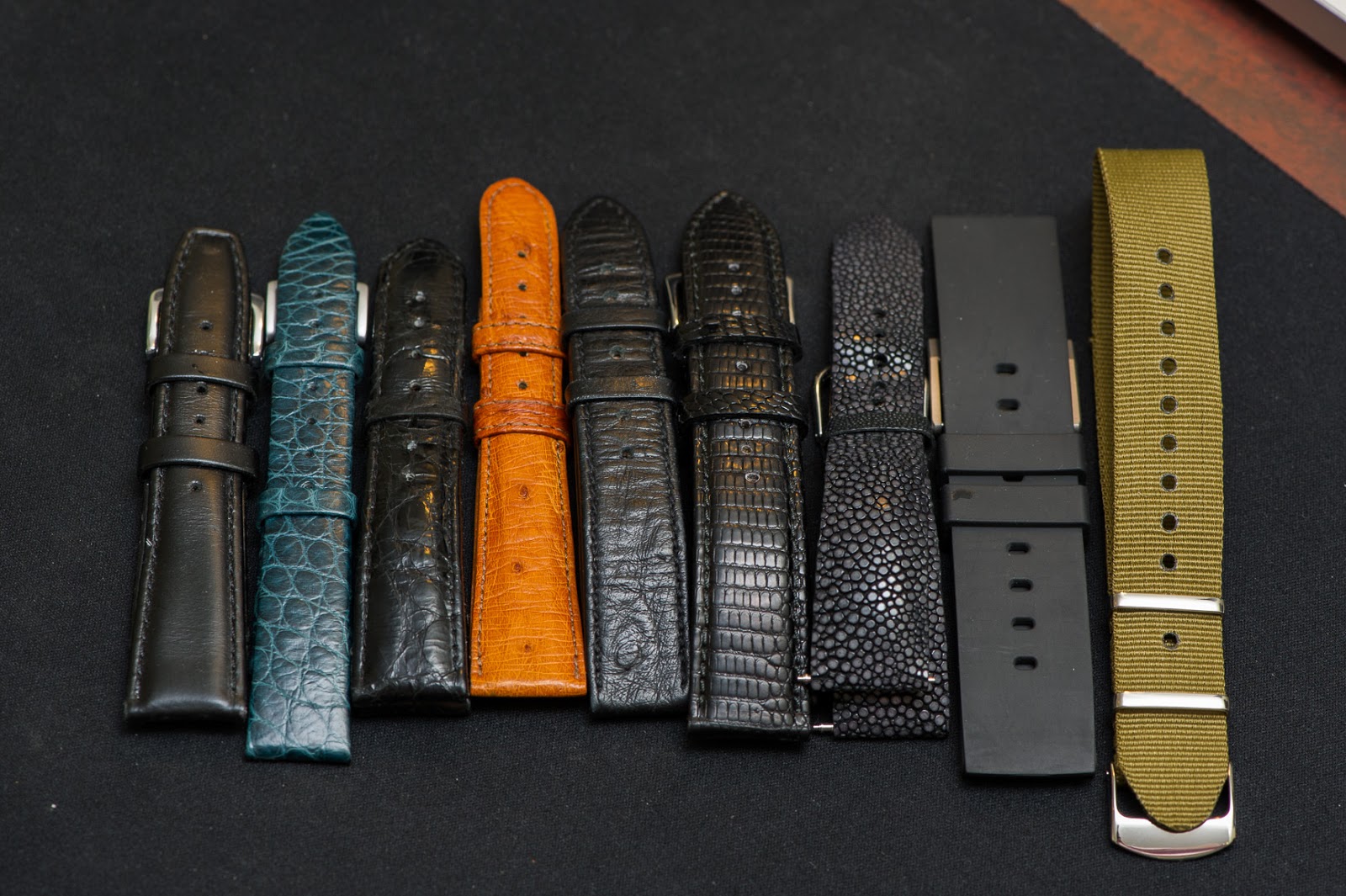
Straps are a fairly popular way of securing watches to wrists, in fact, it is the earliest. Real quality bracelets have only appeared in the past 25 or so years with CNC machining becoming very prevalent. This article will aim to compare different strap materials, with their advantages and disadvantages. The materials presented below (from left to right) are: Medium priced calf leather, blue round scaled alligator, shiny crocodile, tobacco ostrich, black ostrich, black lizard, polished black stingray, black natural rubber (high quality), and olive green Nylon NATO (mid quality). Four more materials: High quality cow leather, square scale alligator, high quality (Maratac) NATO, and horse shell Cordovan are also presented. All exotics are genuine and not embossed cow leather.


That pretty much covers all the strap materials on the market today with the exception of the uncommon shark, and variations of the materials presented such as unpolished stingray, kangaroo, and horse front/rear quarters.


A note about durability: I list two price ranges for each material since the same material can usually be had for very cheap or very expensive. Quality of construction and materials is a much better indication of durability than material.

Cow/Calf leather
Texture: Flat and medium shine to matte. Can also be textured to mimic exotic leathers.
Price: $10-$30 low/medium quality, $50-$150 higher quality full/top grain.
Best for: Most occasions.
Durability: High if top or full grain, medium for other

Cheap corrected grain leather (Leatherworks)

Higher quality top grain leather (notice the tiny follicles) (Not Panerai OEM)

Calf leather is probably the most common leather for most watches, period. This is because of its low cost, high durability, and flexibility of being able to be textured and treated in a variety of ways. My personal recommendation is to spend a bit more and buy a top grain or full grain strap, which can usually be distinguished by the small follicle holes on the surface (although this can also be imitated). Full grain leather has no sanding/buffing treatment and will look good with some polish even when scuffed.

Alligator straps


Texture: Soft and flat
Price: $200-$500 large square scales, $40-$120 smaller scales.
Best for: Daily wear, formal occasions
Durability: Medium


Square scaled alligator (from Glashutte Original)

Round scaled alligator (Hirsch)


By far the most popular strap material for luxury watches is square scaled alligator. It's a generally costly material with most brands charging around 400 dollars for a strap. The quality of the leather can vary greatly, high quality alligator has a soft but firm feel while cheaper alligator straps tend to feel thinner and wear out more easily. It is semi-formal and works well with pretty much any metal case material. Over time, the alligator will lose its shine from wear, resulting in a matte appearance.

Crocodile
Texture: Generally gloss, can also be matte.
Price: $60-$100 lower quality, $150-$300 higher quality.
Best for: Formal occasions (gloss), casual (matte)
Durability: Low

Crocodile strap (debeer)

Along with lizard, the classic leather for dress watches. Crocodile generally appears flatter than alligator and has small wrinkles in between the scales. Generally suitable for formal occasions  glossy crocodile tends to lose its shine if worn very frequently. Generally speaking, alligator is more desirable due to its more 3D appearance  but high quality salt water crocodile or nile crocodile can also be very desirable. 

Ostrich
Texture: rough and highly textured, often with quill bumps
Price: $30-$250 (depending on the brand and quality)
Best for: Casual
Durability: High

Black high quality ostrich (Jaeger-LeCoultre)

Tan ostrich (Debeer)


Although highly interesting, ostrich leather is always very wrinkled. Full quill is more desirable than flat ostrich, although both are similarly durable. Due to its aged appearance, its best suited to more casual occasions.

Lizard
Texture: Glossy
Price: $30-$150 
Best for: Formal
Durability: Low

Black semi-gloss lizard (From Beijing Watch Factory)

High gloss lizard is the most classic formal watch strap material. Highly textured and somewhat fragile, it's most suited to formal occasions. The high gloss finish will wear down somewhat quickly.

Stingray (Also known as shagreen or galuchat)
Texture: Very hard cartilage
Price: $100-$250 depending on polished or not, and pearls vs no pearls
Best for: Most occasions
Durability: High

Polished Black stingray without pearls

Stingray comes in two different textures and two different appearances. Polished stingray (shown above) has the top layer of the small hard bumps polished off leaving a cross sectional series of pebbles while unpolished stingray has sharp bumps on the surface. Pearls are a small patch of white in the middle of the strap that gives it a distinct appearance for which it's charged extra. Stingray is one of the few materials that can not be edge stitched due to its extreme hardness. It's my personal favorite material for straps and is highly durable, water resistant, and suitable for all occasions.

Rubber
Texture: Matte
Price: $10-$350
Best for: Sport/casual
Durability: High

Rubber strap (from MIH watch)

Virtually unknown outside of the sub 200 dollar watch market until Hublot popularized it, rubber has become an increasingly popular material for sports watches. Personally I find it quite uncomfortable and irritating, but that hasn't prevented its rise in popularity. It is only suitable for casual or sports watches and never for formal occasions. 

NATO (Nylon)
Texture: Woven
Price: $10-$300 (lower end for cheaper nato straps, high end for JLC's Condura strap)
Best for: Sport and casual, I don't care about what James Bond wore
Durability: High

Lower quality NATO (from Sea Gull)

High quality NATO (By Maratac)

Designed to keep your watch attached to your wrist even if a springbar fails, the NATO strap has been popular since James Bond wore one in the movie Dr. No. It's a neat material but I find it somewhat irritating due to the hard woven texture. It can work well with any watch but is only really suited to casual occasions, yes, I'm looking at you Bond...

Shell cordovan
Texture: Semi gloss
Price: $100-$250
Best for: Most occasions, perhaps not formal.
Durability: High*

*While very durable and non-creasing, shell scuffs easily.

Shell Cordovan from a shoe (Crockett and Jones for Ralph Lauren, probably tanned by Horween Leather Company)
*Note the waves instead of creases.


Made from the flat muscles of a horse's rumps, shell cordovan is only made by a few tanneries around the world. The most famous of which is Horween in Chicago. This material is extremely tough and has the unique property of not truly creasing. Used by NOMOS for most of its watches, it's an increasingly popular material. However, it should be noted that the leather scuffs rather easily and needs to be polished regularly to maintain a clean appearance  unless you're going to vintage looking route, of course.