Friday, July 19, 2013

Monday, July 1, 2013
A tour of the Hublot manufacturer in Nyon, Switzerland
Hublot is a bit of a controversial name in horology, my opinion of the brand has fluctuated from great admiration in my mid teens (when the big bang was introduced and heavily advertised) to mild contempt after discovering their movements were 7750 based. My current attitude is that the brand has every right to sell a product that was in great demand, but it's still got a bit to prove. The brand is currently around 350 employees producing 35,000 pieces a year and growing rapidly.


I was fortunate enough to visit the Hublot manufacturer last week in Nyon, Vaud canton about 15 minutes by train outside Geneva. The current factory was built in 2009 but the company has already outgrown the building and purchased another building for expansion. All operations take place in the building including movement production (from raw material to the finished movements), casing up, and quality control. Hublot does not make its own cases with the exception of the new ceramic based Magic Gold, and also buys (like almost all manufacturers) its sapphire crystals, straps, jewels, and clasps.


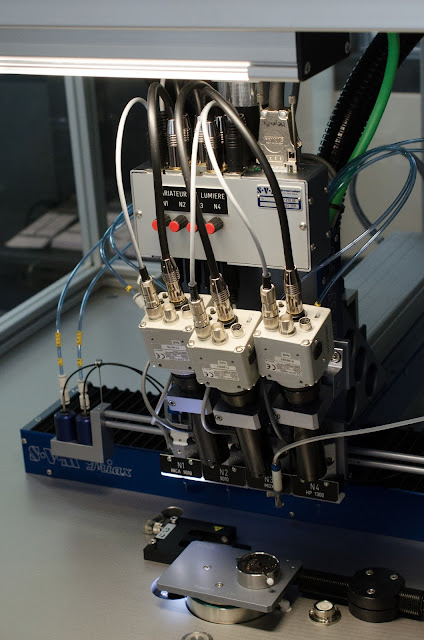
The first part of the building is filled with CNC machines and spark erosion machines used to produce watch parts. I did not notice any machines producing either small parts such as pinions and escapements or silicium parts but they could be elsewhere in the building, although my bet is that silicium parts are purchased from a supplier.


Since the brand focuses on "The art of fusion", many movement parts are made with carbon fiber and other novel materials.


Tucked in the back of the parts manufacture area is a room filled with autoclaves and other machines where Mr. Senad Hasanovic works on producing the new scratch resistant 18 karat magic gold, which is produced by making a ceramic tube that is 75% porous and then forcing pure gold into those spaces to produce 18k (750/1000) ceramic gold. The material behaves the same as ceramic, being extremely hard but slightly brittle. However, it appears like a dark gold alloy and is extremely dense. A new material, which could be named magic aluminium, will take the technique for magic gold but apply it to aluminium to produce a lightweight grey material.


Preassembly involved a semi-automated placing of jewels and small posts into movement parts. The parts are QC'd before being brought to the assembly area where the final watch is assembled. There is a single workshop for producing the in-house UNICO chronograph movement which features a modular escapement with silicium anchor and escape wheel. The movement is not free spring but the brand is certainly aware of the demand for free sprung balances and we may expect to see one in the future.




The haute horology workshop is in a separate area of the building where the brand's finest offerings are finished by hand and assembled by a single watchmaker. Two examples that I was shown are the skeleton tourbillon and minute repeater monopusher chronograph tourbillon.


Despite being rather judgmental about the brand previously, it's understandable that the brand is rapidly growing and there is no reason why it could not eventually produce its own cases and all movement parts. Hublot certainly knows its customers, and how to get even more, and that's an admirable quality in and of itself.


I was fortunate enough to visit the Hublot manufacturer last week in Nyon, Vaud canton about 15 minutes by train outside Geneva. The current factory was built in 2009 but the company has already outgrown the building and purchased another building for expansion. All operations take place in the building including movement production (from raw material to the finished movements), casing up, and quality control. Hublot does not make its own cases with the exception of the new ceramic based Magic Gold, and also buys (like almost all manufacturers) its sapphire crystals, straps, jewels, and clasps.

CNC machining of a mainplate

Machine mainplates, awaiting further treatment (finishing and plating)

Cut brass discs and complete mainplates

The first part of the building is filled with CNC machines and spark erosion machines used to produce watch parts. I did not notice any machines producing either small parts such as pinions and escapements or silicium parts but they could be elsewhere in the building, although my bet is that silicium parts are purchased from a supplier.

Steel parts made from wire-spark erosion


Parts made with wire-spark erosion (passing an ultra high voltage through an extremely thin metal wire)

The wire is the width of a human hair
Since the brand focuses on "The art of fusion", many movement parts are made with carbon fiber and other novel materials.


Tucked in the back of the parts manufacture area is a room filled with autoclaves and other machines where Mr. Senad Hasanovic works on producing the new scratch resistant 18 karat magic gold, which is produced by making a ceramic tube that is 75% porous and then forcing pure gold into those spaces to produce 18k (750/1000) ceramic gold. The material behaves the same as ceramic, being extremely hard but slightly brittle. However, it appears like a dark gold alloy and is extremely dense. A new material, which could be named magic aluminium, will take the technique for magic gold but apply it to aluminium to produce a lightweight grey material.


Material engineer Mr. Senad Hasanovic explains the process of Magic Gold.


Preassembly involved a semi-automated placing of jewels and small posts into movement parts. The parts are QC'd before being brought to the assembly area where the final watch is assembled. There is a single workshop for producing the in-house UNICO chronograph movement which features a modular escapement with silicium anchor and escape wheel. The movement is not free spring but the brand is certainly aware of the demand for free sprung balances and we may expect to see one in the future.

Semi-automatic jeweling operation

The operator places the correct sized jewel in each sink and the machine places them on the part


QC of jewleing operation

Hand driving of jewels for more limited production movements

Diagram of the modular UNICO escapement

Purple silicium escape wheel with stylized "H" spokes

Silicium anchor of the Unico movement


Automatic lubrication machine, applies the perfect quantity of oil on each oiling point


Grease for watch stems and a small pad for noting imperfections on watches
The haute horology workshop is in a separate area of the building where the brand's finest offerings are finished by hand and assembled by a single watchmaker. Two examples that I was shown are the skeleton tourbillon and minute repeater monopusher chronograph tourbillon.


Hand perlage in the haute horologerie workshop


Poising a balance wheel

Classic Fusion Skeleton Tourbillon Titanium

King Power Minute Repeater Chrono Tourbillon (48mm)
Despite being rather judgmental about the brand previously, it's understandable that the brand is rapidly growing and there is no reason why it could not eventually produce its own cases and all movement parts. Hublot certainly knows its customers, and how to get even more, and that's an admirable quality in and of itself.
Wednesday, June 26, 2013
A very worthwhile visit to De Bethune in Geneva (wristshots!)
De Bethune's watches have fascinated me for a long time, but for
various reasons I had been unable to personally handle any of their pieces.
Since I’m in Geneva, I decided to go by their boutique on La Place Longemalle.
Store manager Kevin Bega was an excellent host and showed me plenty of
De Bethune’s offerings. For a brand that produces around 400 pieces a year, it
had a lot to offer, both aesthetically and technically.
Several things stood out to me about the watches. The first
is how highly polished the titanium for many of the cases was, we usually see
titanium as a dull sandblasted grey mass but De Bethune’s almost look like a
combination of platinum and gunmetal. The second is how wearable its large 44mm and 42mm watches are, as an owner of 6.5-inch wrists, any number higher than 40mm is
usually a good indication I shouldn’t even bother trying a watch on, but both
the spring loaded lugs of the DB28 and the drop lugs of the DB25 Imperial
Fountain Snake fit reasonably well. Other admirable characteristics include the
black polished and interestingly shaped plates, round scale alligator lined
straps (presumably by Camille Fournet), and use of silicum in the balance wheel
and escapement and blued titanium for the 3D moon and other components.
I was glad to hear that the power reserve for most movements
was 5 days (4 for the perpetual calendar). I’d perhaps like to see comfortable
deployant clasps instead of the tang buckles, at least as an optional offering.

DB25 Imperial Fountain movement

DB25 with power reserve (40mm)

DB28 Aiguille D’Or limited edition (42.6mm)


Movement of the DB28 Aiguille D’Or limited edition

DB16 Perpetual calendar Tourbillon Dead seconds (43mm)


DB25 Imperial Fountain-Sold in a set of 12 zodiacs. With
mystery-style hands
Subscribe to:
Posts (Atom)