Loupe System is quite an interesting company. Effectively a small startup company who came to BaselWorld in 2013 with a few handmade loupes, the company has grown to serialize production of 4 version of their model 01 loupe. I won't elaborate on details but there are 5 elements in the lens, a 40 mm viewing angle, and 6x magnification. The loupe can act as an iPhone lens for macro photography with their iPhone mount case. As of writing, the price for the cheapest loupe is 525 USD for Rubber, 625 for Carbon fiber, and 800 for Alligator in brown or white, with the iPhone cases being 80 USD.
I opted for the cheapest model as all four are optically the same. My first impressions were overall positive, the loupe came packed in a large cardboard box which contained a pelican-style case (with a manually activated purge valve), cleaning cloth, carrying case, wide view adapter, some papers, and the loupe itself. It also came with a set of formed foam to transform the waterproof case into a case for 4 watches, which was a very nice touch. One complaint I did have was that for the high price, I expected a genuine Pelican case (which cost around 27 dollars on Amazon) with their automatic purge valve.
I'd been using a Belomo 10x triplet loupe for a long time as I love to see the very minute details of the movement. However using the 10x Belomo required lots of light and there was quite a bit of distortion around the edges. The Loupe System is "only" 6x which is pretty standard as a watch loupe. True to their advertising, it lets in plenty of light, has very low distortion, and is very sturdy. On the down side the loupe is positively huge and not pocketable, but neither is a 400 mm f/2.8 lens. Build quality is quite good, with the rubber casing being easily removable (presumably to lower production costs so that the alligator, carbon, and rubber can be interchangeably placed on the same inner metal loupe). The metal housing feels solid but does not have an ultra high end machined feeling, but for the price and presumably low production this isn't surprising.
I think the whether the loupe is "worth it" is a personal question. There's no doubt it costs as much as an overhaul, or high quality alligator strap, but the quality of the loupe is unmatched. I see it as the Patek of loupes, overpriced perhaps, but if you must have the best, it's the only game in town. If the features of letting in a lot of light and almost nonexistent distortion is important for you as a collector to authenticate dials or appreciate your movement with a wide viewing angle, it'll likely be worth it for you.
Loupe System says an attachable LED light is in the works, if properly made with soft lighting this could provide a lot of extra value to the loupe allowing it to be used for high quality viewing and photography in any lighting condition.
Available at: http://www.loupesystem.com
Wednesday, April 2, 2014
Monday, January 27, 2014
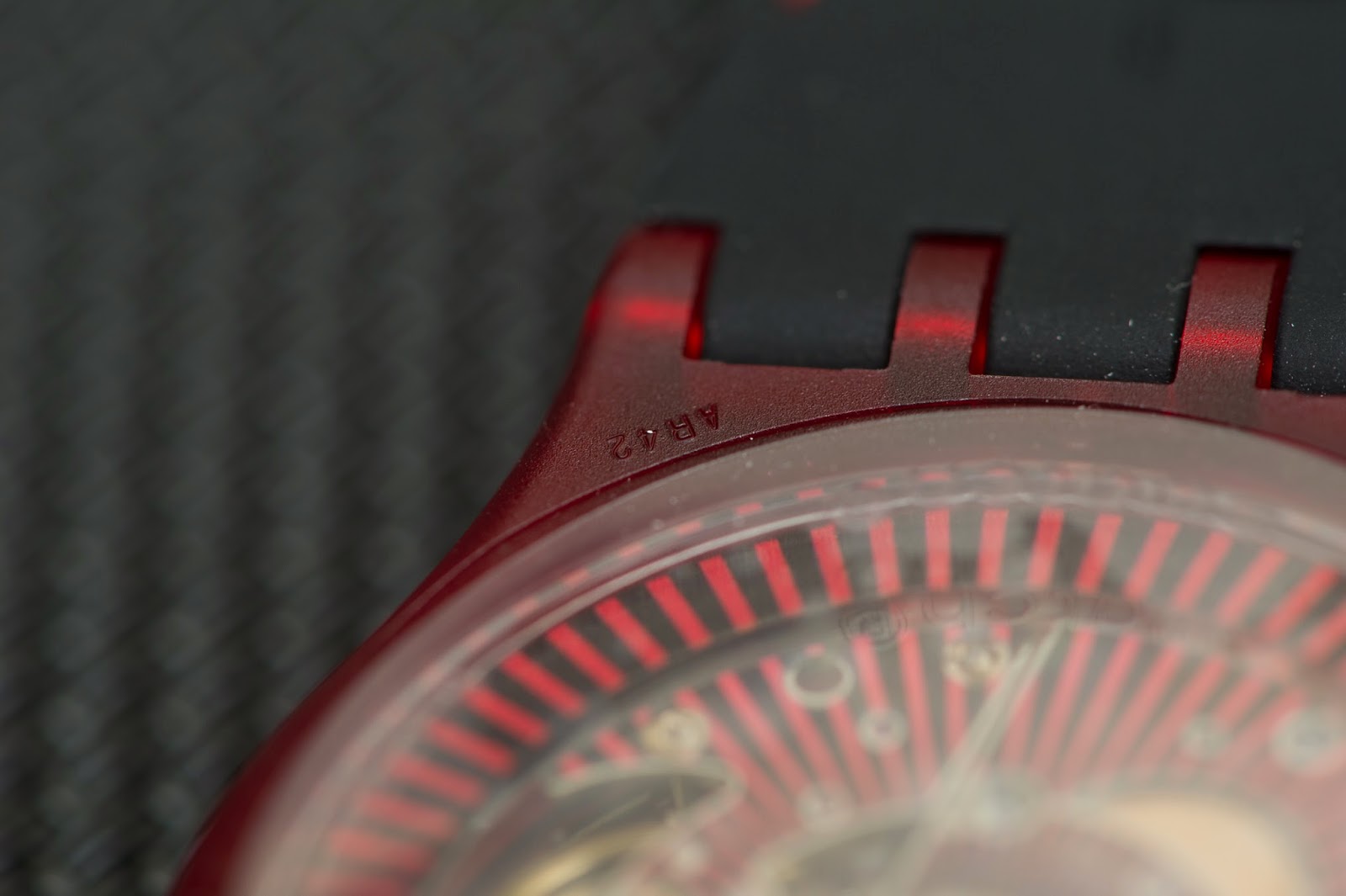
Unapologetically plastic: Swatch Sistem51 Review
The Sistem51 is probably the most interesting watch introduced at Basel 2013, unfortunately it's not until almost SIHH 2014 that we actually saw the watch come on sale in Switzerland.
I've obtained a few and here are my impressions: (disclaimer, I purchased these for resale but will attempt to maintain neutrality in this overview).
The watch, like the iPhone 5C, can be said to be "unapologetically plastic" both inside and out. The watch is almost ironic because of how it satisfies many haute horologerie requirements. There is no dust whatsoever inside the watch, it's immaculate. The escapement is held by a full bridge and is even "free sprung" (but not variable inertia). Adjustment is quite good with amplitude around 270 degrees and a promised 5 second accuracy, presumably on the wrist. I found it was +10 vertical and spot on flat.
The watch features 90 hours of power reserve, this is partly due to the 21.6k vph frequency, precision lubrication and assembly by machine only, and plastic escapement that is likely both light and self lubricating.
A few unusual review notes:
The rotor is undirectional (clockwise winding) and seems to rely on a very high gear ratio since the oscillating weight is plastic.
Hand winding is possible, but it requires turning the crown an unusual counterclockwise.
There is an ETA stamp on both the watch itself as well as the movement.
The movement does not hack
Date change occurs between 11:30 and 1:00 am
Different colours come on different straps. The white version comes on a plain silicon strap, while the black comes on a apparently leather strap, and the red one comes on a stitched silicon strap.
Straps are much more comfortable than I expected.
The rotor sounds a bit loose when shaken, but all 6 I have here have the same sound.
The rotor gives a kind of lightweight but noticeable "Valjoux wobble" when rotating counterclockwise.
Escapement is louder than most watches, probably due to the plastic casing.
Enjoy the photos below!
*My wrist is 6.25" and quite flat
Sunday, January 19, 2014
The Most Important Sub-$1000 watch of 2013: Tissot Powermatic 80 Review
The PowerMatic 80 represents that ultimate democratization of a practical mechanical watch. Coming in at around 600 USD for the steel, non-COSC version, it seems like the steal of the horological century.
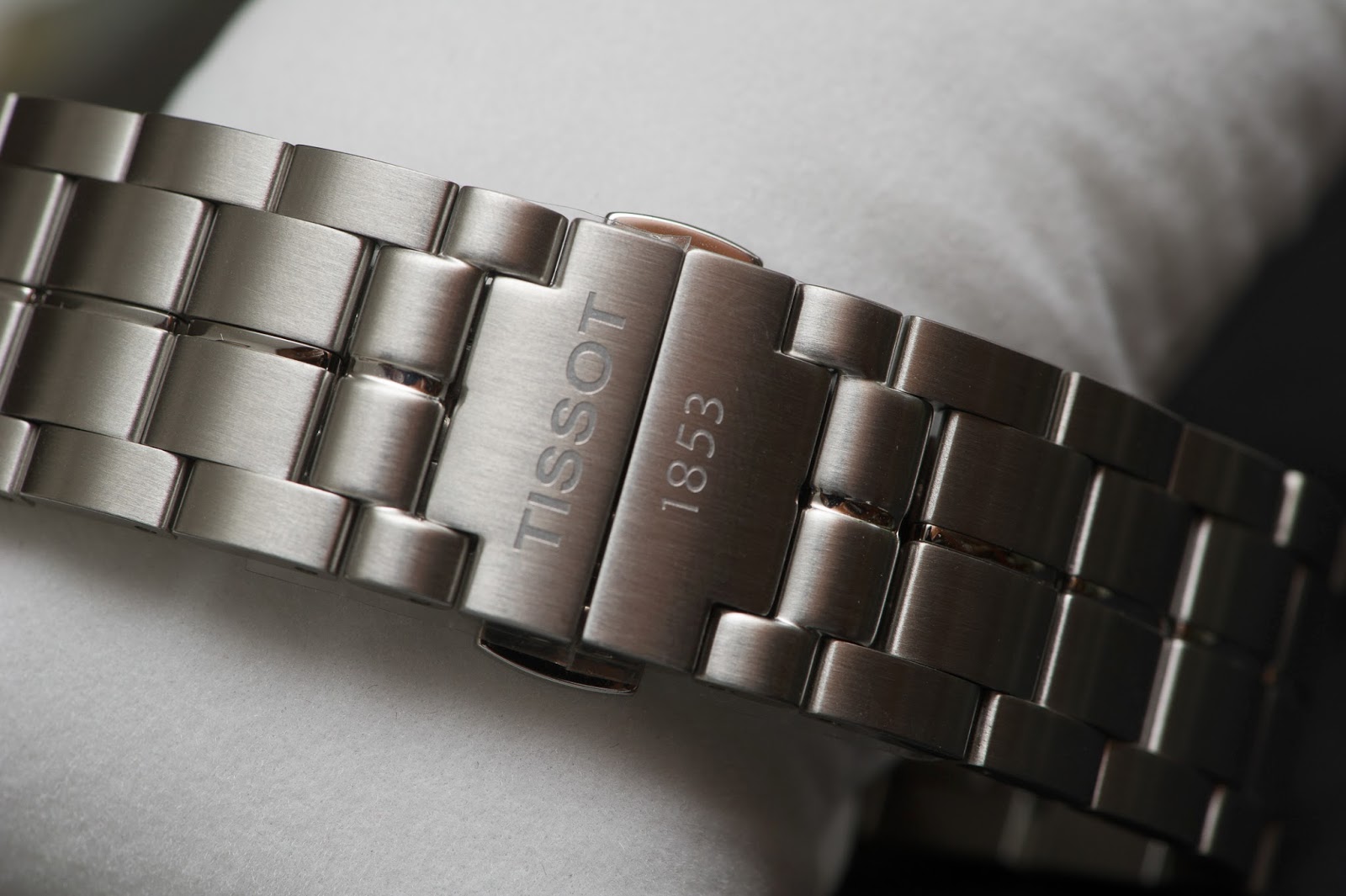
The watch is 41mm in diameter and 9.75mm thick, but wears slightly larger due to its restrained appearance. The case is a mix of brushed, polished, and patterned surfaces which give it a subtle, modern appeal. The front crystal is sapphire and appears to be anti-glare coated, while the rear is a display back which shows the C07.111 movement, a modified ETA 2824 with a reduced frequency of 21,600 vph, new synthetic escapement, and improved hairspring which all contribute to the new 80 hour power reserve.
The 80 hour reserve is the most important, and arguably only, feature of the watch. The 72+ hour power reserve has always been largely in the realm of watches priced above $5000 featuring in-house movements such as the Grand Seikos or the Rolex 4130 movement in the Daytona.
Overall quality
The solid end link bracelet is quite nice, with a brushed finish and a polished line down the middle. The extra links are attached with pressure pins and the clasp is a double deployant. The finish of the case is better than can usually be expected at this price range, but shows some irregularities where the polished and brushed surfaces meet. The dial is a matte black (or matte white) and appeared to be very clean.
Design
With a modern appearance that's very understated, I really feel this watch is a winner in terms of design. The polished details gives it a subtle flash. The lack of literature on the dial is also a huge plus. The watch wears very well and due to its relative thinness, is quite comfortable. The bracelet doesn't have any noticeable sharp edges either.
The bad
I think the watch is, at all levels, perfectly appropriate for its price class. However, with a largely plain dial and relatively small movement, I'd preferred to see Tissot make a 38mm or 40mm version of this watch. This would temper the large expanse of matte black in the center of the dial and make the watch a more serious dress watch option. The choice of a display back, while understandable for marketing, is also dubious. With a crudely finished movement, I'd rather see a nice plain or engraved steel back.
The Powermatic 80 is undoubtedly a huge step forward. While it may never make its way into watches of other brands due to the reduced supply of ETA movements, I hope that more affordable watches can have such a useful features like the long power reserve.
*My wrist is 6.25" in circumference but relatively flat so tends to handle <42mm watches okay.
The watch is 41mm in diameter and 9.75mm thick, but wears slightly larger due to its restrained appearance. The case is a mix of brushed, polished, and patterned surfaces which give it a subtle, modern appeal. The front crystal is sapphire and appears to be anti-glare coated, while the rear is a display back which shows the C07.111 movement, a modified ETA 2824 with a reduced frequency of 21,600 vph, new synthetic escapement, and improved hairspring which all contribute to the new 80 hour power reserve.
The 80 hour reserve is the most important, and arguably only, feature of the watch. The 72+ hour power reserve has always been largely in the realm of watches priced above $5000 featuring in-house movements such as the Grand Seikos or the Rolex 4130 movement in the Daytona.
Overall quality
The solid end link bracelet is quite nice, with a brushed finish and a polished line down the middle. The extra links are attached with pressure pins and the clasp is a double deployant. The finish of the case is better than can usually be expected at this price range, but shows some irregularities where the polished and brushed surfaces meet. The dial is a matte black (or matte white) and appeared to be very clean.
Design
With a modern appearance that's very understated, I really feel this watch is a winner in terms of design. The polished details gives it a subtle flash. The lack of literature on the dial is also a huge plus. The watch wears very well and due to its relative thinness, is quite comfortable. The bracelet doesn't have any noticeable sharp edges either.
The bad
I think the watch is, at all levels, perfectly appropriate for its price class. However, with a largely plain dial and relatively small movement, I'd preferred to see Tissot make a 38mm or 40mm version of this watch. This would temper the large expanse of matte black in the center of the dial and make the watch a more serious dress watch option. The choice of a display back, while understandable for marketing, is also dubious. With a crudely finished movement, I'd rather see a nice plain or engraved steel back.
The Powermatic 80 is undoubtedly a huge step forward. While it may never make its way into watches of other brands due to the reduced supply of ETA movements, I hope that more affordable watches can have such a useful features like the long power reserve.
*My wrist is 6.25" in circumference but relatively flat so tends to handle <42mm watches okay.
Monday, January 13, 2014
Attempted Scammer Alert!!
I believe that most people are good, but in buying and selling watches one can never be too careful. An individual imitating someone I'd dealt with before sent me this email:
Hope all is well. Thanks again for the watch. Quick question for you. I was wondering if you would be interested in a white dial daytona 116520 SS V series in MINT condition w/box and complete papers. A good friend of mine gave it to me to sell for him, he only wants $7,600 for it. Guess he ran into some money issues and needs to sell. I just don't need any more Daytonas right now. Let me know.
Best Regards,
-------
His bank information is:
Bank: Wells Fargo Bank
Full name: Jeremy Honor
Account#: 325-266-0844
Routing#: 121-000-248
Banks address: 1302 W International Speedway Blvd, Daytona Beach, FL 32114
Banks telephone#: 386-254-1830
--------
Fortunately, I never wired the money due to the highly suspcious nature of the emails but this is a warning to anyone looking to buy watches online. The scammer used an email that was similar to the actual individuals and used the same gmail "name".
Another watchnet member had also almost been scammed and his post is here: http://forums.watchnet.com/index.php?t=tree&th=560108&mid=645769&rid=74939&rev=&reveal=
Saturday, November 23, 2013
Sotheby's Jony and Marc's (RED) Auction shatters estimate (featuring a unique JLC Atmos and Memovox)
The full auction results can be seen at Sotheby's here, there were only a few items within or below estimate.
Wednesday, November 6, 2013
The results of the 2013 Concours international de chronométrie
The concours ended with somewhat disappointing results. Interestingly, Tissot beat everyone (and even many of the previous tourbillons) to win the top 2 in the non-tourbillon section. Even more disappointingly only one of the 7 tourbillon entires finished (entires from prestigious makers including Laurent Ferrier, Greubel Forsey, and L.U.C. Chopard did not even pass the torture tests).
Encouragingly, two of the twelve student entires (from Mathieu Douik and Maxime Bettenelli of CIFOM passed.
Full results are below (click to enlarge):
An absolute monster of accuracy (878 and 850 pts.) improving on their 764 pt 2011 result with the 2824.
Encouragingly, two of the twelve student entires (from Mathieu Douik and Maxime Bettenelli of CIFOM passed.
Full results are below (click to enlarge):
Tuesday, November 5, 2013
In another time: My Prodigy M mATX Hackintosh Gaming PC Build
So this blog is suppose to be about watches, but I have other interests too. And after contemplating for a long time I decided to build my own PC. Problem was, I'm a 8+ year old Mac user so switching back to windows was just too much to handle. Hacktintoshing was the only solution I saw, so without further ado...
The parts
I wanted something as compact as possible but also with enough expandability. The number one criteria, of course, was that the parts had to be hackintosh compatible without extensive intervention. I consulted the TonyMacX86 buyer's guide and ended up with the following:
PCPartPicker part list: http://pcpartpicker.com/p/1Y5bZ
Price breakdown by merchant: http://pcpartpicker.com/p/1Y5bZ/by_merchant/
Benchmarks: http://pcpartpicker.com/p/1Y5bZ/benchmarks/
CPU: Intel Core i5-4670K 3.4GHz Quad-Core Processor ($239.99 @ Newegg)
CPU Cooler: Noctua NH-U12S 55.0 CFM CPU Cooler ($68.71 @ Amazon)
Motherboard: Gigabyte GA-Z87MX-D3H Micro ATX LGA1150 Motherboard ($124.99 @ Newegg)
Memory: Crucial Ballistix Sport 8GB (2 x 4GB) DDR3-1600 Memory ($63.99 @ Newegg)
Storage: Crucial M4 256GB 2.5" Solid State Disk ($209.99 @ Adorama)
Storage: Seagate Momentus XT 750GB 2.5" 7200RPM Hybrid Internal Hard Drive ($149.99 @ Amazon)
Video Card: Gigabyte GeForce GTX 770 2GB Video Card ($334.99 @ NCIX US)
Case: BitFenix Prodigy M Arctic White MicroATX Mini Tower Case ($106.98 @ SuperBiiz)
Power Supply: Corsair Professional 750W 80 PLUS Gold Certified ATX12V / EPS12V Power Supply ($129.99 @ Newegg)
Operating System: Microsoft Windows 8.1 Pro - OEM (64-bit) ($139.98 @ OutletPC)
Total: $1547.60
(Prices include shipping, taxes, and discounts when available.)
(Generated by PCPartPicker 2013-11-05 22:45 EST-0500)
I also decided to add a second Noctua NF-F12, as well as 2 NF-P12 FLX fans for intake and a NF-P14 ULN for rear exhaust.
The build process:
It took me a very very long time to build this since this is my first build and I wanted to not break anything. Overclocking was also rather difficult and I ended up settling at a mere 4 GHz. The most difficult part is cable management, and here's a short list of tips to avoid mistakes that I made.
#1. Buy a 165 mm or shorter power supply, the HX750 Gold is 200 mm and has blocked out my only 16x PCIe 3.0 slot. The 770 or even 780 won't saturate PCIe 3.0 8x but I will need to get a new power supply when upgrading the graphics card.
#2. Can I SLI in the prodigy M (realistically). YES! But don't get too excited, on my particular motherboard you'll be running one card in x4 and the other in x16, also the intake fans at the top will definitely not fit and it will be even more crampted than it is now. But I have tried placing a MSI Gaming 770 into the top slot and yes, you can 2 way SLI.
#3. Flip the panels. What? Yes, flip the panels. Hardware canucks mentioned this in their overview of the Prodigy M case. Simply put the panel with the IO on the backplate side and the plain panel on the component side. This will allow for MUCH BETTER cable management.
#4: Get a reasonably sized cooler, the Noctua NH-U12S is probably the best fit here, in push pull only the pull fan is active at low loads, and it can push enough air to keep the CPU cool in a pretty tight space.
#5: You're going to have to reassemble a few times to get it right. The case is just too small to make the process straightforward. Want to add an intake fan? You'll need to remove the GPU and probably the heatsink.
#6: Have large hands? You'll either need to recruit someone with small or skinny hands for this build, plugging in the fan headers for the heatsink, threading cables through other cables, and doing anything in this case requires some serious manual dexterity.
And the result:
The parts
I wanted something as compact as possible but also with enough expandability. The number one criteria, of course, was that the parts had to be hackintosh compatible without extensive intervention. I consulted the TonyMacX86 buyer's guide and ended up with the following:
PCPartPicker part list: http://pcpartpicker.com/p/1Y5bZ
Price breakdown by merchant: http://pcpartpicker.com/p/1Y5bZ/by_merchant/
Benchmarks: http://pcpartpicker.com/p/1Y5bZ/benchmarks/
CPU: Intel Core i5-4670K 3.4GHz Quad-Core Processor ($239.99 @ Newegg)
CPU Cooler: Noctua NH-U12S 55.0 CFM CPU Cooler ($68.71 @ Amazon)
Motherboard: Gigabyte GA-Z87MX-D3H Micro ATX LGA1150 Motherboard ($124.99 @ Newegg)
Memory: Crucial Ballistix Sport 8GB (2 x 4GB) DDR3-1600 Memory ($63.99 @ Newegg)
Storage: Crucial M4 256GB 2.5" Solid State Disk ($209.99 @ Adorama)
Storage: Seagate Momentus XT 750GB 2.5" 7200RPM Hybrid Internal Hard Drive ($149.99 @ Amazon)
Video Card: Gigabyte GeForce GTX 770 2GB Video Card ($334.99 @ NCIX US)
Case: BitFenix Prodigy M Arctic White MicroATX Mini Tower Case ($106.98 @ SuperBiiz)
Power Supply: Corsair Professional 750W 80 PLUS Gold Certified ATX12V / EPS12V Power Supply ($129.99 @ Newegg)
Operating System: Microsoft Windows 8.1 Pro - OEM (64-bit) ($139.98 @ OutletPC)
Total: $1547.60
(Prices include shipping, taxes, and discounts when available.)
(Generated by PCPartPicker 2013-11-05 22:45 EST-0500)
I also decided to add a second Noctua NF-F12, as well as 2 NF-P12 FLX fans for intake and a NF-P14 ULN for rear exhaust.
The build process:
It took me a very very long time to build this since this is my first build and I wanted to not break anything. Overclocking was also rather difficult and I ended up settling at a mere 4 GHz. The most difficult part is cable management, and here's a short list of tips to avoid mistakes that I made.
#1. Buy a 165 mm or shorter power supply, the HX750 Gold is 200 mm and has blocked out my only 16x PCIe 3.0 slot. The 770 or even 780 won't saturate PCIe 3.0 8x but I will need to get a new power supply when upgrading the graphics card.
#2. Can I SLI in the prodigy M (realistically). YES! But don't get too excited, on my particular motherboard you'll be running one card in x4 and the other in x16, also the intake fans at the top will definitely not fit and it will be even more crampted than it is now. But I have tried placing a MSI Gaming 770 into the top slot and yes, you can 2 way SLI.
#3. Flip the panels. What? Yes, flip the panels. Hardware canucks mentioned this in their overview of the Prodigy M case. Simply put the panel with the IO on the backplate side and the plain panel on the component side. This will allow for MUCH BETTER cable management.
#4: Get a reasonably sized cooler, the Noctua NH-U12S is probably the best fit here, in push pull only the pull fan is active at low loads, and it can push enough air to keep the CPU cool in a pretty tight space.
#5: You're going to have to reassemble a few times to get it right. The case is just too small to make the process straightforward. Want to add an intake fan? You'll need to remove the GPU and probably the heatsink.
#6: Have large hands? You'll either need to recruit someone with small or skinny hands for this build, plugging in the fan headers for the heatsink, threading cables through other cables, and doing anything in this case requires some serious manual dexterity.
And the result:
Subscribe to:
Posts (Atom)