Showing posts with label Jaeger LeCoultre. Show all posts

Sunday, November 18, 2012

Journey of Reverso: Part 4.2 (Current Reverso Duo Harmonized MK II)

Most of the information from my post about the older version of this watch stand, the only difference is in the dial and pusher as well as a minor difference in the winding feeling, testing procedure, and new 3 atm water resistance.
Part 4.1 here has all the details about the movement and the watch.


The exact same movement

This is just a brief comparison of the previous and current version of the Reverso Duo in stainless steel on a bracelet. JLC's leather straps are without doubt of the finest quality but are priced at over 400 dollars retail.  So the bracelet is usually a good choice at initial purchase and a fine quality after market strap works very well.


The key differences in the two models are in the dial and the pusher. The movement is the exact same in the two iterations and from what I can tell the bracelets are the same.


 Old dials (courtesy of JLC via PuristSPro)

New dials (note the wave pattern on the white dial is not visible)
(Courtesy of JLC via PuristSPro)

The new white dial has a waved guilloche pattern in the center portion of the dial and a round seconds hand dial while the older version had a diamond guilloche pattern and a rectangular seconds dial. The small textured dots around the perimeter of the dial have been removed. Lettering is still printed instead of applied and personally I prefer the older dial with the finer details.

The black dial has also been simplified, the previous version had a circular wave pattern center dial with a diamond patterned outer dial. The markers were also applied. The new version has a plain center dial and printed markers. I'm not sure which one looks better but given the classical nature of the watch, I personally prefer the older version, especially since I prefer applied to printed markers. Those seeking a simpler watch, especially to be worn on a strap, will likely prefer the older dial with finer details to contrast with the strap while the bracelet may look better with the newer dial, but that's just a matter of personal opinion.


The pusher is probably the biggest source of debate amongst collectors. The old version worked just fine and even came with a tool with which to push the pusher, advancing the hour hand of black dial in one hour increments. The new version is more "user friendly" since it can be pushed like a chronograph pusher. Granted the recessed pusher could be made to be water resistant and is the method still widely used for adjusting functions such as perpetual calendars and moonphases, I neither understand or appreciate the change. It makes the watch less symmetrical and proportional, which is probably the biggest aesthetic selling point of the Reversos (remember the golden ratio of 1:1.6).


Overall, I prefer the older version a lot more, the only advantage I can really give to the mark ii is the 3 atm water resistance and 1000 hour control test, but those are largely meaningless for a watch that was never mean to be worn around water.

Thursday, November 8, 2012

JLC Amvox 7: Press release and specs


The partnership between Jaeger-LeCoultre and Aston Martin celebrates its eighth anniversary with the presentation of the AMVOX7, the first vertical-trigger chronograph equipped with a power reserve display. The legendary AMVOX line seduces both lovers of fine watches and motor-sports fans alike.

A refined design equipped with intuitive functions
The AMVOX7 Chronograph immediately attracts the attention with the motif that decorates its dial; it reproduces the design on the radiator grille of the Vanquish, the very latest model unveiled by Aston Martin last June. The titanium case is distinguished by extremely refined technical finishes. New functions have now been introduced into the AMVOX line for the first time: an intuitive display method that is in perfect accord with the sensation of immediacy conferred by a sporting outlook and the power reserve display. In 2005 the Manufacture Jaeger-LeCoultre first presented its brand new vertical-trigger chronograph. Like all revolutionary inventions, this system seems so simple and straightforward that athletes wanting to time their performances are wondering how they could ever have done without it. Quite simply, pressing at 12 o’clock stops or starts the chronograph mechanism, while pressing at the bottom of the dial resets the chronograph hands to zero.

A technical performance that is up to the challenge
With regard to the AMVOX’s “motor”, fine watch connoisseurs will appreciate the Jaeger-LeCoultre 756 automatic mechanical calibre. With its frequency of 28,800 vibrations per hour and its 65-hour power reserve, it has an impressive profile in terms of robustness, reliability and accuracy. The comparison between the AMVOX’s “motor” to that of the new Aston Martin Vanquish is inevitable.

The vitality of any collaboration depends on the enthusiasm contributed by each of the partners. As the partnership between Jaeger-LeCoultre and Aston Martin enters its eighth year, it is stronger than ever. This is a collaboration that has already given birth to exceptional creations representing major advances in the technical domain. The secret of this continued success lies exclusively in a shared vision based on a mutual passion for innovation.

JLC Caliber 756


Jaeger-LeCoultre Calibre 756
Movement: Automatic
Pieces number: 335
Vibrations per hour : 28800
Power-reserve : 65 Hours
Jewels: 39
Barrel: 2
Height: 7.39 mm
Functions: Hour. Minute, Large date display, Movement operating indicator, Power-reserve, Vertical-trigger chronograph Hour counter 30-minute counter 60-second counter
Case: Titanium
Water resistance : 5 bar
Dial: Black skeletonised
Hands: Bâton à facette
Strap/bracelet: Alligator Leather
Buckle: Double Folding Buckle 20.0 mm
Price (MSRP): 26,000 USD

Saturday, October 20, 2012

Journey of Reverso: Part 4.1 (Reverso Duo Pre-Harmonized MKI/Day & Night)

We finally come back to one of my favorites, the Reverso. The reverso duo is one of the most practical incarnations of the Reverso, especially for travelers. This part is about the original Reverso Duo released in 1994 which was subsequently replaced 10 years later in 2004 with the "harmonized" version (more on the differences later).


A few wristshots on my 6.5" wrist


This particular model is modestly sized at 26mm x 42mm x 10mm which is more or less the same size as the Reverso GT. This iteration features a diamond patterned guilloche on the white "day" dial and a radiating wave guilloche pattern on the black "night" dial. The hands on the day side are blued while the hand on the back are lumed with tritium. Overall, the dials are very pleasing to the eye and my favorite part is the rectangular seconds hand frame contrasted with the round 24 hour indicator on the back.


Photo courtesy of JLC
The specs for this piece are:
Ref. 270.8.54
26 x 42 x 10 mm
JLC Caliber 854/1
Dual time zones, back hour hand adjusted in one hour increments via pusher
3.8mm high
KIF shock protection
Flat hairspring
180 parts
21,600 vph
45 hr power reserve
Not water resistant (pre-harmonized version)
Price: around 6500 USD at release on leather band
Note: This piece also came in a white gold version with a slightly different movement that had a day/night indicator on the black side.


A point of minor complaint


The size was pretty good for me, although perhaps a tad too long, making it seesaw a bit on my bony wrist. The bracelet was comfortable and extremely well finished but has no fine adjustment on the plain butterfly clasp. The bracelet is held together by spring bars which makes adding links quite easy. I have to say that the lume is completely useless but it's not really expected that anyone use it anyways. The pushpiece to advance the "night" hour hand works pretty well and can be operated via toothpick or the dedicated pushing tool provided. While I like to have a date mechanism, that would somewhat ruin the beauty of the piece. I just have to say, this is a superb piece, the size is perfect and the functions are useful.

For more technical information, the old Purists site has a great page on this piece:
http://www.network54.com/Forum/234648/thread/1055687624/Reverso+Duo+Technical+Drawing+Pls

Thursday, October 4, 2012

Review of LeCoultre Memovox ref. 2677 cal. K910

With this post, I think my blog is starting to turn into a JLC blog, but do not despair my friends, there will be non-JLC watches. But today is not that day.


The Memovox is somewhat of a cult watch, if such a title can be given to anything other than the Rolex Submariner or Omega Speedmaster. Although it is certainly not the first alarm watch, it's definitely the most well known. Debuted in 1951 with the Cal. 489 (developed in 1949) and followed by 12 versions ending with the Cal. 956 used in the current Memovox. Only the most recent 5 movement references (Cal. 919, 918, 914, 909/1, 956) starting in 1989 with the Grand Reveil perpetual calendar/alarm and its Cal 919. These ringing Memovoxes use a gong to make a bell ringing sound, the others all used a vibrating hammer that makes the sound shown in the video in my previous post.


Some specs of the example I have:

LeCoultre (with VXN stamped on the movement) movement for the US market
Model Ref. 2677
Circa 1962-1964
Cal. 910
Movement introduced in 1962
Two mainsprings (one for time and one for alarm)
17 Jewels
13''' (29.3 mm) diameter, 5.15 mm thickness
KIF flector antishock
3 bridge design (as opposed to the 3/4 design)
Glucydur balance
19,800 vph


Watch is 34.5mm diameter, 38 mm long, 10 mm thick (including high domed acrylic crystal).
Stainless steel made by the Star Watch Case Co. in Michigan (now defunct)
Monocoque case design (movement can only be removed from the front by removing the crystal)
Applied markers with tritium paint, with typical 1960's arabic numerals at 12, 3, 6, and 9.
Silver dial with "T Swiss T" marked at the bottom.
Lug width 19mm


The movement itself requires a typical 40 turns to fully wind and lasts approximately 36 hours (never measured). The watch is not water resistant in any way whatsoever, like most vintage watches, so water must be avoided like the plague.


There's not all that much to say about the watch except a few points about purchasing. Overall it's very wearable and, at least for my small 6.5 inch wrist, is a pleasure to wear. 19mm straps used on most memovoxes are not a standard size and may prove more difficult to get, but it's only a minor nuisance. The alarm is an interesting complication although not the most useful given it's 10 second duration and 50 decibel loudness. It's by no means a piece of haute horologerie and the American made LeCoultre cases reflect this more so than its European counterparts marked Jaeger LeCoultre. The movements for both markets are the exact same but the cases are not held to the same esteem. The case on my example has unbeveled lugs that appear quite industrial. Some American cases can be up to the Swiss made standards but it's more misses than hits.


Regarding the materials, many US Memovoxes are gold filled, which means that the case is made of some nonprecious base metal which is covered in 14 or 18 karat gold foil at least 1/10th the weight of the case itself.  While these cases have gold much thicker than gold plating would allow, I prefer either solid stainless steel cases or solid gold cases. Gold plating, gold filling, and even rhodium plated white gold feel like a bit of a lie to me. To quote my friend Amanico over at Purists "Gold filled is like bastards, neither gold nor steel." This is, of course a sack full of personal opinion and you should always buy whatever makes you happy.


Memovox Video


My video demonstrating the sound of vibrating Jaeger LeCoultre Memovoxes. Full review and scans in the next post.

Monday, October 1, 2012

Comparison: Patek 215 PS versus Vacheron Constantin 1400

While the Calatrava seems to garnish all the attention, one often overlooked but worthy opponent is the Patrimony by Vacheron Constantin, especially the Contemporary in platinum with a platinum dial (pt950). The two are often eerily similar, both using refined JLC ebauches. In this case, the ultra thin automatic JLC Cal. 920 spawns three great movements: The Patek 28-255C, the VC 1120, and AP 2121. The Patek and VC are both similarly finished (despite Patek's recent migration to its own PP seal instead of the Geneva Seal) with a Gyromax free sprung balance.


However, recently things have taken a turn, and since manufacturers like Breitling are even no longer satisfied using ebauches, both watches have started to migrate towards in-house movements. The VC now uses the VC Cal. 1400 and the Patek uses their Cal. 215 PS. Being very much so a movement enthusiast, it's disappointing that although prima facie, the two movements look similar, closer inspection reveals the superiority of the Patek. One reason is perhaps the price difference of USD 7,700 (Patek is USD 39,600 and VC is USD 31,900) which can buy a steel JLC Master Control with money saved. Another is Vacheron's relative inexperience in making movements, while a superb finisher and complication builder, Vacheron acquired HDG in 1998 in order to establish VCVJ (Vacheron Constantin Vallee de Joux) which now does all the component manufacturing for the company. The 1400 was the first movement by the renamed establishment and so the less than perfect mainplate finish could be forgiven.

Philippe Dufour is reported to have complimented on the finish of the 1400, but he seems not to have gotten a look underneath the main bridges. The bridges are indeed beautiful and more elegantly shaped than the Patek with the only visible complaint being the lack of a free sprung balance wheel.


(Photo from VC via The Hour Lounge)

A superb review of the 215 can be found at timezone: http://people.timezone.com/library/horologium/horologium631671451971451015
(Photo from Purists)

and a review by ei8htohms of the 1400 reviews its minor shortcomings on Purists.

The movements are pretty similar, both are 9''' (21.9 mm), 28,800 vph, the Patek is 2.55 mm thick and 18 jeweled and the VC is 2.6 mm and 20 jeweled. Both were Geneva Seal but recently the Patek bears the PP seal. According to watchtime, the Patek is extremely accurate with a max deviation of 3 seconds and averaging a mere +0.2 seconds a day while the VC deviates a max of 6 seconds averaging +1.5 seconds a day.

Let me know in the comments what you think, or does the accuracy not matter since both are dress watches anyways.

Wednesday, September 12, 2012

Journey of Reverso: Part 3 (Reverso Gran'Sport Chronograph)

In looking for something quite innovative, I had always thought that dual sided Reversos represented the most logical use of the Reverso case. What impressed me the most about the Gran' Sport is its uniqueness amongst Reversos. While the Squadra is proportionally (1:1.6) not a bona fide golden ratio Reverso, the Gran'Sport line is (and is the only other Reverso that bears the same proportion other than the traditional reversos. Another appeal of the watch is its size, at a modest 28.3 mm x 43.5 mm x 12.6 mm, only a hair larger than the Reverso GT I reviewed previously. The movement is an original chronograph movement and as far as i know the only dual sided chronograph.


Slightly barreled case, compared with the GT cased Reverso Duo


Basics Specifications:
Functions: Recto: Time, date. Verso: Chronograph with seconds hand and 30 minute retrograde counter.
Water resistant 5 atm (not 1000 Hr control)
Caliber 859, based on caliber 829
Manual wind
45 Hour power reserve
38 Jewels
317 components
28,800 vph
4.5 mm high
Column wheel control of chronograph functions


The only real photo of caliber 859 anywhere, courtesy of PuristSPro

Integrated bracelet/strap design in case material and rubber only.
MSRP (Last known in USD). Steel version on steel bracelet 15,000. Steel on rubber strap 14,250. Gold on gold bracelet  30,400. Gold on rubber strap 23,750.
Dial versions: White or grey, with applied triangular markers or printed linton numerals
Released 1998, discontinued 2006


If you want more technical information about the merits of this watch, Purists has a wonderful article linked below.

http://www.network54.com/Forum/234648/thread/1055556997/Information+on+the+Gran%27Sport+Chronographe

I can only comment on the overall experience of wearing the watch. Personally, while gold is an admirable material, the Gran'Sport is in all essence a sports watch and is better in the steel version. Although I prefer the steel bracelet for comfort, the rubber strap is a suitable match as well. The back of the case has two curved ridges that elevate the case back off the wrist for comfort. The watch wears similarly to a 38mm watch and wraps very well around the wrist. The integrated bracelet has brushed center links and polished outer links and is wonderfully comfortable with two 4mm adjustments at the clasp (standard on newer JLC sports bracelets).

The bracelet is designed with removable spring bars all along the bracelet, and the case is attached via a notched bar and a screw securing the notch which should prove more reliable than a spring bar.

Accuracy is excellent and within 1 second a day and the seconds hand glides smoothly. Chronograph pushers are not wobbly and the chronograph function works just as promised. With the possible exception of the price, it's probably the ultimate sports watch. In theory it's possible to go swimming with it but I certainly haven't tried and sometimes I wish the water resistance was a healthier 100m.

Video review: Reverso Gran'Sport Chronograph (Watch in 720!)


Friday, August 31, 2012

Journey of Reverso: Part 2 (Reverso GT Grande Taille)

Before I start this review, I think it's best to review some comparison shots from the last reverso I reviewed.


 Size comparison between the GT and the Squadra


After deciding that the squadra was perhaps not the best fit for my 6.5 inch wrist, I moved onto a Reverso GT with a ostrich strap. I had always liked the idea of a classic and constrained Reverso with slightly modern proportions.


The current JLC Reverso GT


The first JLC Reverso (1931)
The older "pre harmonized" GT


Basic specs:
42.2 x 26 mm x 9.5 mm
Water resistant to 3 atm
Time only
Caliber 822, manually wound, 134 parts, 21,600 VPH, 45 hr power reserve, 21 jewels, KIF shock protection (2), flat hairspring. Introduced in 1992, 22.6 mm x 17.2 mm x 2.3 mm.
Current materials: 18K pink gold, stainless steel (both on strap or respective bracelet)
MSRP (USD): 7,150 (Steel on Alligator), 8,100 (Steel on steel), 15,900 (pink gold on alligator), 30,300 (pink gold on pink gold) (Current as of Aug 31)


The version I purchased at the time was not the current version, although it uses the same movement and has the same case dimensions, there are two key differences: The dial does not have the wave guilloche, and it is not water resistant.

I think as a dress watch, this is the pinnacle. I used to consider the Reverso Tribute to 1931 the best but after trying it on and loving the watch as just a watch, I decided it was too large to serve it's correct purpose at 46 mm x 27 mm. Both watches use the same movement and are somewhat similarly thin (2.5 mm difference). There's not much to talk about regarding the movement, it's modestly finished, reliable, and has been in production for 20 years and used in a variety of watches from JLC reversos and also some Dunhill watches.

In some ways, perhaps more ways than one, this is a particularly boring watch. It's definitely a staple watch and a classic dress watch which is exactly what makes it quite boring. The dial of this vintage version is plain silver with printed numerals, the back is plain steel, and the clasp was a single deloyant clasp which made the standard length strap terrible for small wrists. The current version has a wavy guilloche dial, and a double deployant but despite the new deployant, the standard strap is still too long for a balanced fit (this is one of the reasons I prefer tang buckles).

Overall, it's a boringly well proportioned watch (as dress watches should be) housing a modest movement, but despite these characteristics, I have no qualms recommending this to anyone with nearly any wrist size. Strap problems can be overcome and nothing can beat the reverso for aesthetically perfect proportions (1:1.618).

Thursday, August 23, 2012

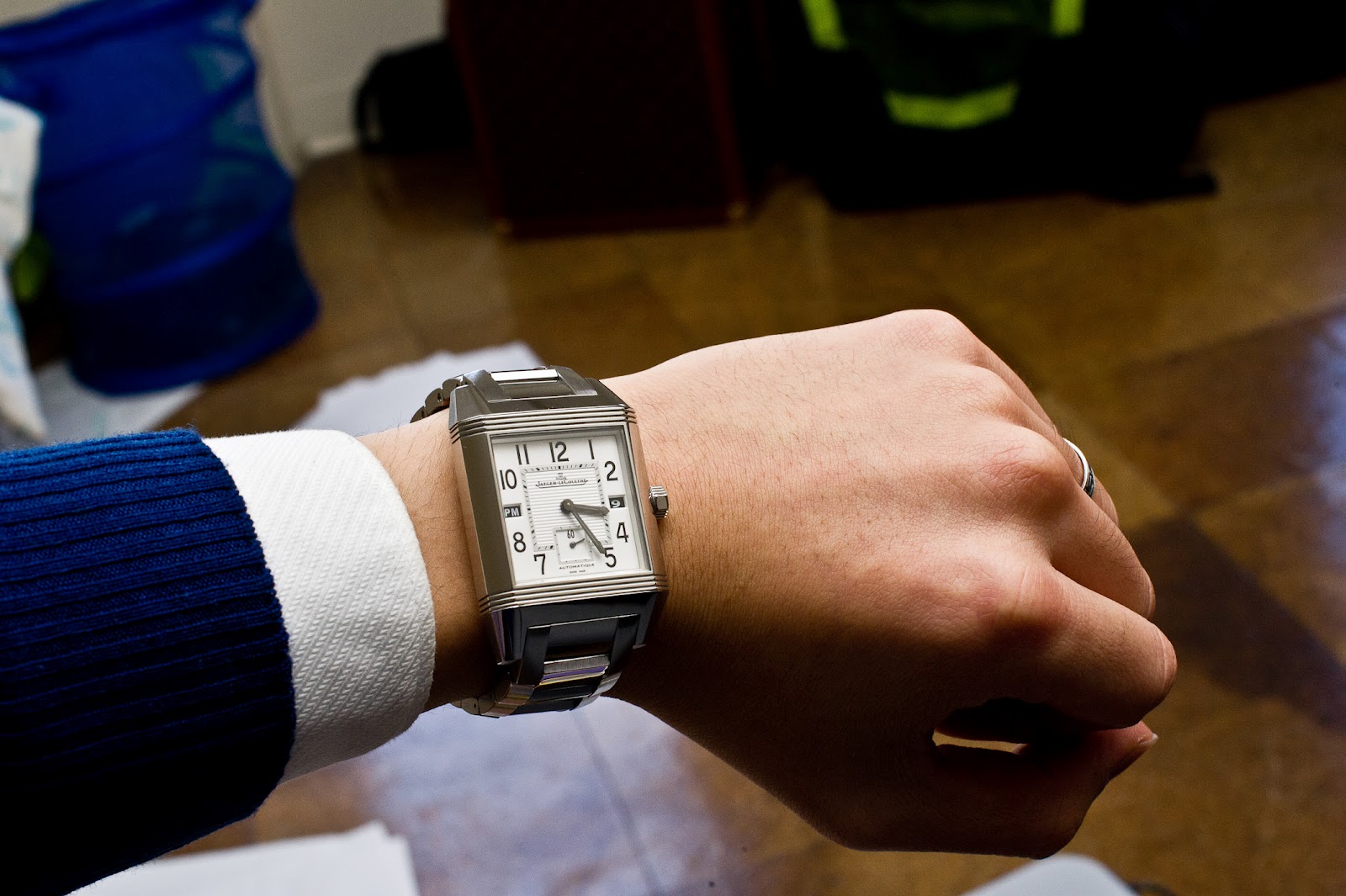
Journey of Reverso: Part 1 (Reverso Squadra Hometime)


This is a series I'm doing about the five JLC Reversos I've owned in the past year, It will be updated weekly.


After thoroughly considering my upgrade options from the Breitling I received as a present, I settled on none other than Jaeger-LeCoultre. The brand was all in-house, generally well finished, and above all, of excellent value. After debating for some time I settled on the Reverso Squadra Hometime on a steel bracelet (Ref. 7008120 or 230.8.77). The choice was simple: The Reverso has the strongest JLC DNA, It had an innovative and strong 977 autotractor movement and was, in my opinion, the modern incarnation of the classic reverso which had been a sports watch. It also came on a bracelet which I prefer for durability and versatility.


I didn’t get a chance to try it on my 6.5 inch wrist so when it came, I learned that it was extremely large. The dimensions are 50.5 mm x 35 mm x 14 mm, but don’t let the 35 mm fool you, due to the fixed end links on the bracelet, the case is well over 50 mm long.


Some basic specs:

Released in 2006
JLC 977 “Autotractor” movement: Mechanical automatic winding, 234 parts, 29 jewels, 28,800 VPH, 48 hr power reserve.
Ceramic ball bearings
Freesprung balance with 4 adjustment screws and flat hairspring, incabloc.
Balance bridge
Stop seconds mechanism
GMT "hometime" indication with Day/Night indicator
JLC rocker style unidirectional automatic winding mechanism.
Rhodium plated with blued screws.
Slightly curved Sapphire crystal on both sides
Water resistant to 5 atm
MSRP (USD): 8,000 steel on alligator and rubber, 9,350 steel on steel, 21,100 rose gold on articulated rubber or alligator, 39,100 rose gold on rose gold (prices current as of Aug 23rd 2012)

Performance/movement

The watch certainly has no problems performing, on my wrist it was running a consistent 5.5 seconds fast everyday. JLC adjusts their watches so that they never run slow in any position. The disadvantage to reversos is that due to the difficulty of taking apart the case, adjustments can’t be done as easily or cheaply. The movement, as written on Purists for the 975 movement which the 977 is based on, is nice but not stellar. The superfluous holes drilled in the bridges for the CNC process are distracting, and the weight is not 22k gold as on most other models. It’s certainly pretty to look at, just not THAT pretty.


The GMT function worked quite well, the skeleton "home" hour hand stays the same while the normal hour hand can be moved around in one hour increments. The AM/PM indicator is synced to the skeleton "home" hand while the date is synced to the normal hour hand. The date is not quick setting but can be set in both directions due to the innovative maltese cross date mechanism.


I personally don't feel comfortable moving any hand on the watch but JLC says it's fine.

Bracelet

The bracelet is quite nice feeling, links are attached with screws. I had an issue where one of the screws kept coming loose regardless of how often they were tightened, my watchmaker recommended some blue Loctite but I just tightened the screw when I saw it come out. The edges of the bracelet are quite sharp which in my opinion is appropriate for this very geometric watch. There are 2 micro extensions on both sides of the clasp that will extend the bracelet by 4 mm at a time, this is essential to getting a good fit for the bracelet.


Bracelet before extension


Bracelet after 4 mm extension


Case 

The case is the same as a standard reverse case, only a lot bigger and square. The perlage on the inside of the steel backing is as fine as ever. The edges are again, quite sharp and the only issue I had was when I wore dress shirts, the edge of the case rubbed against the shirt and formed a persistent bit of white power on the inside of the case. This is not really an issue since the watch is a sports watch and not meant to be worn with work or formal clothing.


Perlage on back plate


The white fibers


Always fun to watch the rotor spinning, and quite smoothly too!

A word about the dial:
After having seen the more expensive black dial version, I believe that the white silver dial is the way to go, the simple horizontal guilloche is perfectly harmonized for the watch. 

This was my first reverso, with many to come, and if you have a 7+ inch wrist, it would be a great fit. It’s a solid tank of a watch with a movement to match.

Just keep in mind it’s as thick as a Rolex Sea Dweller and wears as large as a 44mm Panerai. Don't expect a Patek finish either.

Jaeger Lecoultre Reverso Squadra Review, JLC Reverso squadra review, JLC review, caliber 977, autotractor,