Showing posts with label Swiss Watches. Show all posts

Thursday, January 24, 2013

Studies and photos of Jaeger LeCoultre Caliber 849

If you're a watchmaker, the tech sheets and oiling charts can be found here:

http://www.phfactor.net/wtf/Jaeger%20Le%20Coultre%20Tech%20Sheets/1151_JLC%20849.pdf

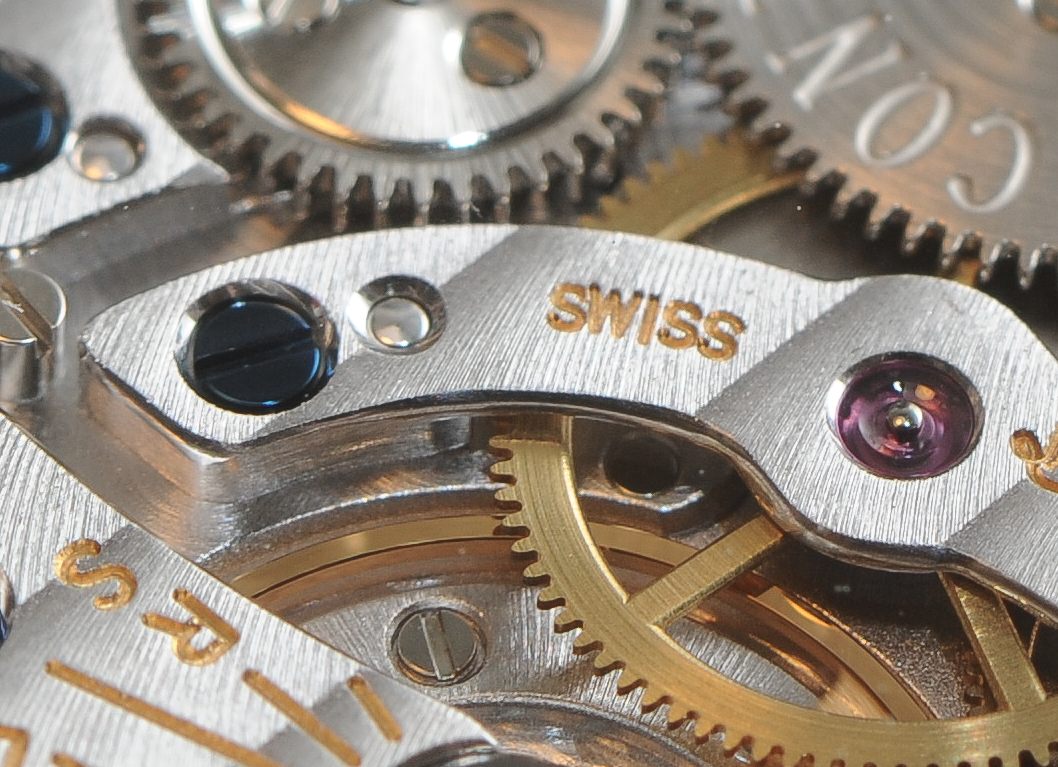
Since I'm a movement nerd, naturally, I wanted to know everything about that little caliber residing inside my new Master Ultra thin. After scouring the internet, old catalogs, magazines, and JLC's press archives. I've dug up the following information and photographs. The two full reviews of the 849 movement are done by Walt Odets of Timezone (although actually of the 839 movement) and ei8htohms of PuristS (now PuristSPro).

TimeZone 839 Review
PuristS 849 Review

Please note that the macro photos are my own work and are free to use with proper credit:


Recto


Verso


Basic information:
Released in 1994

123 parts
19 rubies
Four bridge configuration
21,600 vph
1.85mm high
9''' (20.8 mm diameter)
KIF shock protection
Flat hairspring (Nivarox 1)
35 hour power reserve on one barrel
Other features: 2 armed stepped balance wheel, chamfered heat blued and polished screws, Cote de Geneve finish, Master Control 1000 hour QC, polished jewel and screw sinks.


Based on Caliber 839, which is based on caliber 838 (18 jewels, 121 parts, 3 bridge configuration)), which has its roots in the JLC ebauche for VC caliber 1003/AP 2003 (both 18 jewels, 1.64mm high, 18,000 vph, flat hairspring, 9''', 35 hour power reserve).


Used in (current as of SIHH 2013):
JLC Master Ultra Thin (33.4 mm, 4.2 mm high, measured by me to be closer to 34 mm by 6 mm due to domed sapphire, sapphire case back), Master Ultra Thin 38 (38 mm, 6.31 mm thick), Master Ultra Thin Jubilee (180 anniversary, 39 mm, platinum only, solid case back, 4.05 mm thick). Additionally, it is used in a variety of cases based on the first two mentioned, often with high jewelry design.


Below are scans from the 2002/2003 JLC "The Manufacture's Book of Timepieces"


Sunday, November 18, 2012

Journey of Reverso: Part 4.2 (Current Reverso Duo Harmonized MK II)

Most of the information from my post about the older version of this watch stand, the only difference is in the dial and pusher as well as a minor difference in the winding feeling, testing procedure, and new 3 atm water resistance.
Part 4.1 here has all the details about the movement and the watch.


The exact same movement

This is just a brief comparison of the previous and current version of the Reverso Duo in stainless steel on a bracelet. JLC's leather straps are without doubt of the finest quality but are priced at over 400 dollars retail.  So the bracelet is usually a good choice at initial purchase and a fine quality after market strap works very well.


The key differences in the two models are in the dial and the pusher. The movement is the exact same in the two iterations and from what I can tell the bracelets are the same.


 Old dials (courtesy of JLC via PuristSPro)

New dials (note the wave pattern on the white dial is not visible)
(Courtesy of JLC via PuristSPro)

The new white dial has a waved guilloche pattern in the center portion of the dial and a round seconds hand dial while the older version had a diamond guilloche pattern and a rectangular seconds dial. The small textured dots around the perimeter of the dial have been removed. Lettering is still printed instead of applied and personally I prefer the older dial with the finer details.

The black dial has also been simplified, the previous version had a circular wave pattern center dial with a diamond patterned outer dial. The markers were also applied. The new version has a plain center dial and printed markers. I'm not sure which one looks better but given the classical nature of the watch, I personally prefer the older version, especially since I prefer applied to printed markers. Those seeking a simpler watch, especially to be worn on a strap, will likely prefer the older dial with finer details to contrast with the strap while the bracelet may look better with the newer dial, but that's just a matter of personal opinion.


The pusher is probably the biggest source of debate amongst collectors. The old version worked just fine and even came with a tool with which to push the pusher, advancing the hour hand of black dial in one hour increments. The new version is more "user friendly" since it can be pushed like a chronograph pusher. Granted the recessed pusher could be made to be water resistant and is the method still widely used for adjusting functions such as perpetual calendars and moonphases, I neither understand or appreciate the change. It makes the watch less symmetrical and proportional, which is probably the biggest aesthetic selling point of the Reversos (remember the golden ratio of 1:1.6).


Overall, I prefer the older version a lot more, the only advantage I can really give to the mark ii is the 3 atm water resistance and 1000 hour control test, but those are largely meaningless for a watch that was never mean to be worn around water.

Thursday, November 8, 2012

JLC Amvox 7: Press release and specs


The partnership between Jaeger-LeCoultre and Aston Martin celebrates its eighth anniversary with the presentation of the AMVOX7, the first vertical-trigger chronograph equipped with a power reserve display. The legendary AMVOX line seduces both lovers of fine watches and motor-sports fans alike.

A refined design equipped with intuitive functions
The AMVOX7 Chronograph immediately attracts the attention with the motif that decorates its dial; it reproduces the design on the radiator grille of the Vanquish, the very latest model unveiled by Aston Martin last June. The titanium case is distinguished by extremely refined technical finishes. New functions have now been introduced into the AMVOX line for the first time: an intuitive display method that is in perfect accord with the sensation of immediacy conferred by a sporting outlook and the power reserve display. In 2005 the Manufacture Jaeger-LeCoultre first presented its brand new vertical-trigger chronograph. Like all revolutionary inventions, this system seems so simple and straightforward that athletes wanting to time their performances are wondering how they could ever have done without it. Quite simply, pressing at 12 o’clock stops or starts the chronograph mechanism, while pressing at the bottom of the dial resets the chronograph hands to zero.

A technical performance that is up to the challenge
With regard to the AMVOX’s “motor”, fine watch connoisseurs will appreciate the Jaeger-LeCoultre 756 automatic mechanical calibre. With its frequency of 28,800 vibrations per hour and its 65-hour power reserve, it has an impressive profile in terms of robustness, reliability and accuracy. The comparison between the AMVOX’s “motor” to that of the new Aston Martin Vanquish is inevitable.

The vitality of any collaboration depends on the enthusiasm contributed by each of the partners. As the partnership between Jaeger-LeCoultre and Aston Martin enters its eighth year, it is stronger than ever. This is a collaboration that has already given birth to exceptional creations representing major advances in the technical domain. The secret of this continued success lies exclusively in a shared vision based on a mutual passion for innovation.

JLC Caliber 756


Jaeger-LeCoultre Calibre 756
Movement: Automatic
Pieces number: 335
Vibrations per hour : 28800
Power-reserve : 65 Hours
Jewels: 39
Barrel: 2
Height: 7.39 mm
Functions: Hour. Minute, Large date display, Movement operating indicator, Power-reserve, Vertical-trigger chronograph Hour counter 30-minute counter 60-second counter
Case: Titanium
Water resistance : 5 bar
Dial: Black skeletonised
Hands: Bâton à facette
Strap/bracelet: Alligator Leather
Buckle: Double Folding Buckle 20.0 mm
Price (MSRP): 26,000 USD

Sunday, November 4, 2012

What does a Patek Minute Repeater sound like?

The time being chimed is 11:58

Eleven Ds, Three F# D, and Thirteen F#

DDDDDDDDDDD F#D F#D F#D F#F#F#F#F#F#F#F#F#F#F#F#F#


A Photographic History of Patek Philippe Perpetual Calendar Chronographs


To understand why Patek Philippe is the industry leader requires a separate article which I will write later, but of all the watches that Patek makes, two stand out the most: The perpetual calendar chronograph and the minute repeater. 

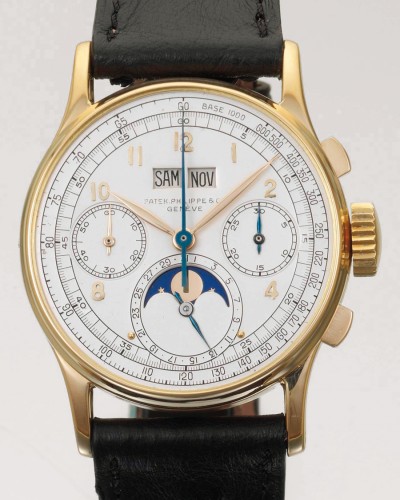
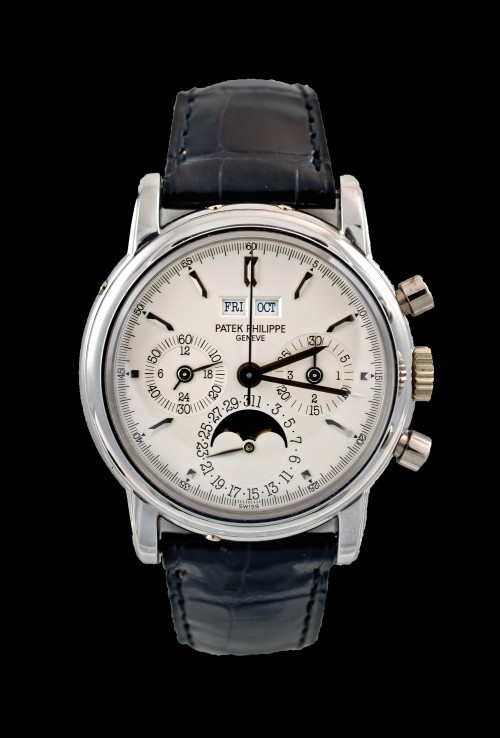
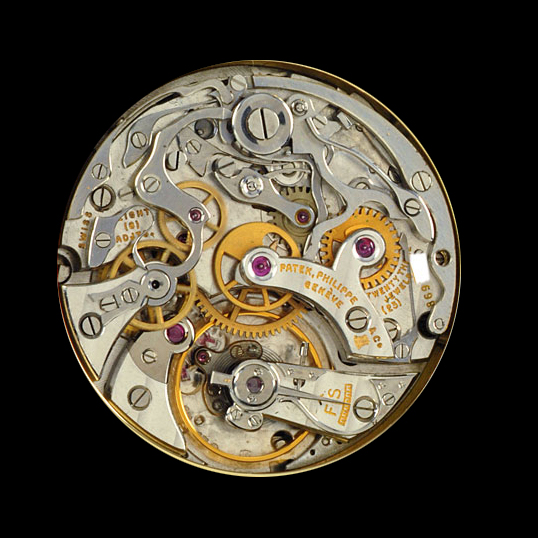
Patek made the first perpetual calendar chronograph with ref. 1518 in 1941 and has been making them continuously since. They have all been column wheel chronographs in the most traditional way with the column wheel covered from direct view. Below is a section taken from a Bonham'sauction describing the history of the Patek QP CH (Quantieme Perpetuel, Chronographe)

Ref 1518 from 1941 until 1952 produced in 281 examples 

(WatchTime Magazine)

Ref 2499 from 1950 until 1985 produced in 349 examples
First model with sapphire crystal


(Antiquorum Auction)

Ref 3970 from 1986 until 2005 produced in approximately 4,000 examples 

(HarrisConor Auction)


Ref 5970 from 2005 until 2010 produced in approximately 2,500 examples 

(minutemachines)

Ref 5270 from 2011

(Patek Philippe)

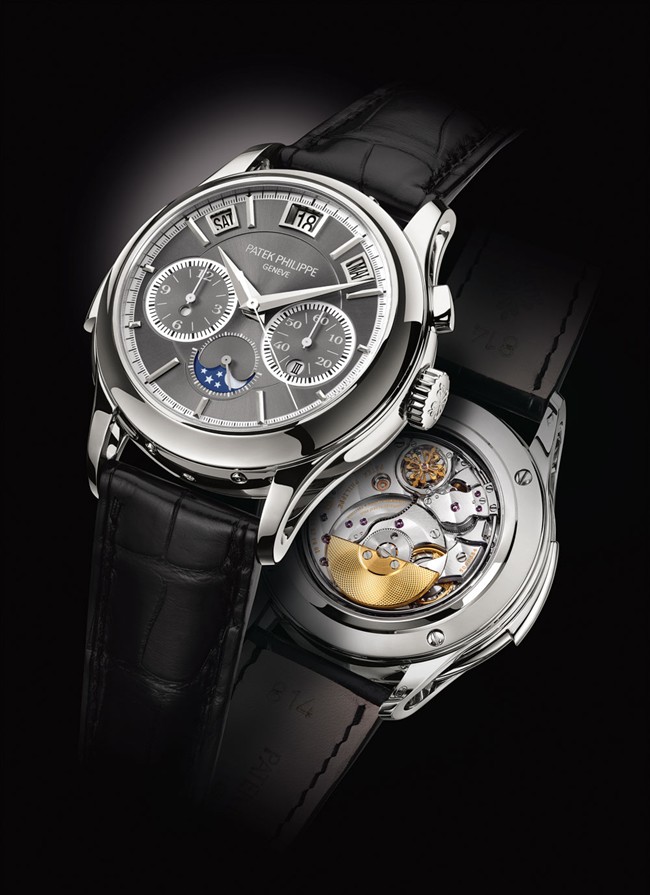
Honorable mention: Patek ref. 5208 (2011) Perpetual Calendar, Chronograph, Minute repeater. Probably the epitome of the brand sans tourbillon. 

Video of a Thierry Stern interview featuring the watch.


Honorable Mention II: 5204 Perpetual Calendar, split seconds chronograph (there are others in this series like the 5004 but these do not belong in the line of perpetual calendar chronographs discussed in this post).

Saturday, November 3, 2012

Eric Clapton's Platinum Patek Philippe 2499P at Christie's (and what you could buy instead)

A quick photographic history of Patek Philippe Perpetual Calendar Chronographs is here

Christie's auctions have been known to offer some of the rarest and most exceptional watches. This upcoming auction is no exception. While the whole horological world seems to have their eyes set on the platinum Patek Philippe 2499 owned by Eric Clapton (estimate $2,683,456 - $4,293,529), I have my eyes set on a few other very interesting pieces being offered namely the...


Probably the highest resolution photo of the watch in question you'll find anywhere


Eric Clapton wearing the Patek 2499P

Actually during the middle of this post, after researching the 2499 a bit more, the LeCoultre Reverso from 1933 and the Paul Newman Daytona and the Double Red Submariner all seem to matter a lot less than the holy grail that is the 2499P. How could I not geek out about this watch?


At a basic level, the 2499 is a perpetual calendar and a chronograph cased in platinum. At the current market value (1,543 USD/oz) it's worth between 106.34 and 173.91 pounds (or 48 and 79 KG) of pure platinum. A perpetual calendar, while expensive, can be had new for around 10,000 dollars from the respectable Glashutte Original, and a column wheel chronograph from Longines starts at around 3,000 dollars retail. You could even buy this watch in yellow gold for around 300,000 at auction and have a life size platinum statue of yourself made!


Oval Buddha, Platinum plated. Takashi Murakami

So why would anyone on earth buy this instead of a statue that could inspire Shelly into writing Ozymadias? To get the absolute answer you'll probably have to find the anonymous buyer and ask him about it. I think it's fair to say that this watch is so valuable because of the rarity, the beauty, the history, and the craftsmanship - Things you will find in all exemplary watches.

Hodinkee has an excellent article about this watch along with a video

Friday, November 2, 2012

Best Watch Videos #2: Patek Philippe Maintenance Video

Maintenance is obviously important for any mechanical object be it cars, bikes, guns, or watches. While manufacturer service, in my experience, tends to cost 20% more than your local watchmaker, I recommend that any fine timepiece be taken back to Switzerland for their maintenance.

Here is some Patek Philippe Propaganda about their overhaul service with the service prices below. Patek's prices are slightly more expensive than other brands but only by about 25%, except for the fact that they do not include polishing which is standard with most brands.
Service cost is really something that should be strongly considered when buying a watch, a moon phase, although not particularly useful, can add to the cost of service greatly (as I so found out after having my Glashutte serviced).


The short version ~8 min (Available in 720 HD)


The long version with Thierry Stern ~17min (Available in 720 HD)


Thursday, November 1, 2012

Part 2 of 2: Review of the Rolex Submariner No Date (14060M/Cal. 3130)

Part 1 with history and specs here

I laid down some history and specifications for the Rolex No Date Submariner (14060M) in part 1. The last known retail price of this discontinued model was 6,300 USD in its only version: Steel on a steel bracelet.

Now I can get on with the actual reviewing part. I purchased the watch used for the market price at the time after deciding that I "needed" a Rolex since that was what I had wanted since the 6th grade. I have a fair amount of experience with fine timepieces and I was initially not impressed. I understood and appreciated the history but in the steel, it wasn't as impressive as I had hoped. I eventually found out why and was able to resolve that issue.


A wrist shot with the OEM steel bracelet


You can even pretend to be Bond, James Bond


Watch head
The watch head itself was well finished and had no annoyingly sharp edges which I absolutely hate. The edges are polished while everything else is brushed. The 904L steel that Rolex loves to advertise is slightly darker than 316L used in most watches but that difference is not so apparent. The 14060M is the last Rolex to have lug holes, a feature I very much appreciate since it makes switching out the bracelet much easier.


Polished side with traditional lug holes


As far as dials are concerned, the dial is glossy but quite plain. Personally I believe that the two line (non-COSC) version is much more attractive due to the watch being a "tool watch". I would have preferred a tritium markers with the characteristic yellow patina but opted for the more advanced movement instead (the 14060 was the last model to have the tritium markers).


Untouched photo showing the glare of the sapphire crystal


The uncoated sapphire crystal is completely flat which, along with the plain dial and mostly brushed case gives the watch an understated feeling. A convex and coated sapphire crystal with a lightly textured dial would have made the watch feel more expensive but would also take away from the Rolex heritage embodied in the watch and move it towards being a Breitling.

Bezel
The bezel is aluminium and will scratch, but can be replaced very easily. I prefer the newer ceramic bezel inserts but at the same time wished it was less shiny and looked more like the aluminium one. The bezel turns smoothly and has 120 clicks.

Movement
The particular example I had was running around 15 seconds fast despite demagnetizing it, while this bothered me quite a bit the 3130 movement is generally known to be a very solid performer that keeps time within COSC specifications (+6/-4 seconds per 24 hours).


The triplock crown (note the three dots)


One very important and special feature of the movement how it manual winds. Most watches with screw down crowns will wind in the first crown position but also wind as you're the crown down. Modern Rolex movements will only wind in the first position but not as it's being screwed down.

Because of Rolex's unique winding system, the movement is exceptionally quiet, but I've never owned anything with a 7750 in it so I've not had loud winding issues before with other watches.

Bracelet
Now comes the cause of my grievance. The bracelet on the submariner is by pretty much any description and evaluation terrible. It's reasonably comfortable, has removable links secured by screws, and light (due to its hollow components), but I can honestly think of no other merit.  I understand that the watch is a "tool watch" and that it's staying true to its roots with the tuna can bracelet, but they can certainly do better while staying true to heritage.
75% made of stamped metal


End Links
The end links are stamped from metal and bent into shape, a feature I would expect of watches priced under 1000 dollars only. These bend over time and even though they may be bent back into shape, it is no excuse for a brand that everyone thinks so highly of. They have since resolved this with the newer 114060 iteration of the 14060 but the newer bracelet is neither obtainable nor backwards compatible.


Made of stamped metal


The bracelet itself isn't much better, the center links are hollow (read bent sheet metal) and are known to "stretch" overtime. This stretch is actually the rivet fastening the links together wearing down the holes in the links.


An example of stretch
Courtesy of clockmaker.co.au


For small wrists, the bracelet is bad as well, and it's unlikely to fit wrists 6.5 inches and under in a balanced way (clasp on the direct bottom of the wrist) without forcing off a permanent link with a vice grip.


Perhaps something not everyone is interested in doing


The Clasp
The clasp is stamped of stainless steel and feels light and flimsy. The diver's extension does not properly secure onto the clasp with the second smallest micro adjustment hole being used.


Thin clasp


Sheet metal

The flimsy diver's extension


Concluding remarks and on the wrist
For those wanting to have a Rolex for a good price, this watch is definitely the way to go (used). For a tool watch, I would have to say forget about it. There are much better options for about 1/35th the price (one that I will review eventually).

As much as I hate the bracelet, the watch is a pleasure to wear and shines up to a classic beauty with a grey polished stingray strap. I'm just not sure the price, even used, is justified for this watch. All modern mechanical movements can take a lickin' and keep on tickin' and there are much higher quality pieces available at this price level. But regardless, I can't argue with the power of the brand and the heritage.

Part 1 of 2: Review of the Rolex Submariner No Date (14060M/Cal. 3130)

Part 2 with opinions here

The Rolex Sub is probably the most popular single "nice" watch in the general population. Ironically, it's also the most common upscale beater watch. For those who don't know, a beater is just a whatever watch that is worn during activities where the owner fears damaging more expensive watches. One should also know that as of 2012, the 14060M has been discontinued in favor of the 114060, more on the differences below.

While I won't go into the history of the watch too much since Jake has it covered more than I ever could here:

http://rolexblog.blogspot.com/2007/07/part-7-rolex-submariner-through-time.html

All that needs to be said is that it was introduced in 1953 and has remained largely unchanged for the past 60 years. Another interesting bit is that it didn't break the 200 USD barrier until the later half of the 1960's.


A whopping 195 dollars!


The 14060M is preceded by the 14060, the difference being the 14060 has the older 3000 movement while the 14060M has the 3130 movement. Later iterations of the 3130 has the parachrom bleu hairspring.

The differences between the 3000 and 3130 movement are evolutionary rather than revolutionary. The 3130 has a free sprung variable inertia balance wheel with a Breguet overcoil hairspring that is secured by a full balance bridge while the 3000 has a variable inertial balance wheel with a flat hairspring fastened by a balance cock.


The 3000 movement

In theory the balance bridge is more shock resistent but I've never heard of watches breaking because the balance cock shifted. A more common cause for broken watches is broken balance staffs that the shock protection (KIF on both movements) seeks to reduce.

The exterior of the 14060 and 14060M are identical (although some may claim differences in minute details such as dial depth and even thickness). For those interested in the date version (16610), note that the non-date is 0.5 mm smaller in diameter and 1 mm thinner.


The specs for the 14060M that is the subject of this review are:
Dimensions: 39.5 mm x 11 mm
Lug Width: 20mm
One version only: Black dial, 904L stainless steel case and bracelet
Non-COSC, Superluminova dial (later versions are COSC while earlier versions have Tritium lume)
White gold indices.
Non solid end links and hollow middle links
Triplock crown
Fliplock bracelet made of stamped 904L steel.


The 3130 movement:
28.5 mm diameter (12 lignes)
6 mm thick
31 jewels
KIF shock protection
50 hour power reserve on one mainspring
Rolex winding system with no ball bearings

A thorough review and dissection of the 3135 movement (date version of the 3130) is here:


The newer 114060 has the same 3130 movement but with the parachrom bleu hairspring with solid end links and a machined solid clasp. It also has a ceramic bezel insert (as opposed to a painted aluminium one). It also has blue lume in place of the traditional green.