Sunday, November 18, 2012

Journey of Reverso: Part 4.2 (Current Reverso Duo Harmonized MK II)

Most of the information from my post about the older version of this watch stand, the only difference is in the dial and pusher as well as a minor difference in the winding feeling, testing procedure, and new 3 atm water resistance.
Part 4.1 here has all the details about the movement and the watch.


The exact same movement

This is just a brief comparison of the previous and current version of the Reverso Duo in stainless steel on a bracelet. JLC's leather straps are without doubt of the finest quality but are priced at over 400 dollars retail.  So the bracelet is usually a good choice at initial purchase and a fine quality after market strap works very well.


The key differences in the two models are in the dial and the pusher. The movement is the exact same in the two iterations and from what I can tell the bracelets are the same.


 Old dials (courtesy of JLC via PuristSPro)

New dials (note the wave pattern on the white dial is not visible)
(Courtesy of JLC via PuristSPro)

The new white dial has a waved guilloche pattern in the center portion of the dial and a round seconds hand dial while the older version had a diamond guilloche pattern and a rectangular seconds dial. The small textured dots around the perimeter of the dial have been removed. Lettering is still printed instead of applied and personally I prefer the older dial with the finer details.

The black dial has also been simplified, the previous version had a circular wave pattern center dial with a diamond patterned outer dial. The markers were also applied. The new version has a plain center dial and printed markers. I'm not sure which one looks better but given the classical nature of the watch, I personally prefer the older version, especially since I prefer applied to printed markers. Those seeking a simpler watch, especially to be worn on a strap, will likely prefer the older dial with finer details to contrast with the strap while the bracelet may look better with the newer dial, but that's just a matter of personal opinion.


The pusher is probably the biggest source of debate amongst collectors. The old version worked just fine and even came with a tool with which to push the pusher, advancing the hour hand of black dial in one hour increments. The new version is more "user friendly" since it can be pushed like a chronograph pusher. Granted the recessed pusher could be made to be water resistant and is the method still widely used for adjusting functions such as perpetual calendars and moonphases, I neither understand or appreciate the change. It makes the watch less symmetrical and proportional, which is probably the biggest aesthetic selling point of the Reversos (remember the golden ratio of 1:1.6).


Overall, I prefer the older version a lot more, the only advantage I can really give to the mark ii is the 3 atm water resistance and 1000 hour control test, but those are largely meaningless for a watch that was never mean to be worn around water.

Sunday, November 11, 2012

Most expensive watch ever could end up back on the block

This recent Bloomberg article states that Sheikh Al-Thani, the cousin of the Emir of Qatar, owes Sotheby's some 83 million dollars for unpaid auctions. He has now pledged a portion of his collection to repay this debt. The most important piece is the Henry Graves Supercomplication, which sold in 1999 for a groundbreaking 11,002,500 dollars (equivalent to 14,671,799 in 2011 dollars). That was the most expensive price for a watch at the time and should still be considering it was only superseded by a 25 million dollar chunk of diamonds made by Chopard (that may or may not have ever sold). 


The "most expensive watch" today is not really a watch


The watch was made in 1933 for the famous NY banker Henry Graves and houses 24 complications. With the watch potentially in Sotheby's possession, it is likely we will see the ultra complicated pocket watch for sale again in the near future. I don't believe it will fetch that sort of price today, but time will tell.


Patek Caliber 89, slightly more complicated but similar to the Graves watch

Thursday, November 8, 2012

JLC Amvox 7: Press release and specs


The partnership between Jaeger-LeCoultre and Aston Martin celebrates its eighth anniversary with the presentation of the AMVOX7, the first vertical-trigger chronograph equipped with a power reserve display. The legendary AMVOX line seduces both lovers of fine watches and motor-sports fans alike.

A refined design equipped with intuitive functions
The AMVOX7 Chronograph immediately attracts the attention with the motif that decorates its dial; it reproduces the design on the radiator grille of the Vanquish, the very latest model unveiled by Aston Martin last June. The titanium case is distinguished by extremely refined technical finishes. New functions have now been introduced into the AMVOX line for the first time: an intuitive display method that is in perfect accord with the sensation of immediacy conferred by a sporting outlook and the power reserve display. In 2005 the Manufacture Jaeger-LeCoultre first presented its brand new vertical-trigger chronograph. Like all revolutionary inventions, this system seems so simple and straightforward that athletes wanting to time their performances are wondering how they could ever have done without it. Quite simply, pressing at 12 o’clock stops or starts the chronograph mechanism, while pressing at the bottom of the dial resets the chronograph hands to zero.

A technical performance that is up to the challenge
With regard to the AMVOX’s “motor”, fine watch connoisseurs will appreciate the Jaeger-LeCoultre 756 automatic mechanical calibre. With its frequency of 28,800 vibrations per hour and its 65-hour power reserve, it has an impressive profile in terms of robustness, reliability and accuracy. The comparison between the AMVOX’s “motor” to that of the new Aston Martin Vanquish is inevitable.

The vitality of any collaboration depends on the enthusiasm contributed by each of the partners. As the partnership between Jaeger-LeCoultre and Aston Martin enters its eighth year, it is stronger than ever. This is a collaboration that has already given birth to exceptional creations representing major advances in the technical domain. The secret of this continued success lies exclusively in a shared vision based on a mutual passion for innovation.

JLC Caliber 756


Jaeger-LeCoultre Calibre 756
Movement: Automatic
Pieces number: 335
Vibrations per hour : 28800
Power-reserve : 65 Hours
Jewels: 39
Barrel: 2
Height: 7.39 mm
Functions: Hour. Minute, Large date display, Movement operating indicator, Power-reserve, Vertical-trigger chronograph Hour counter 30-minute counter 60-second counter
Case: Titanium
Water resistance : 5 bar
Dial: Black skeletonised
Hands: Bâton à facette
Strap/bracelet: Alligator Leather
Buckle: Double Folding Buckle 20.0 mm
Price (MSRP): 26,000 USD

Tuesday, November 6, 2012

A. Lange & Söhne Lange Zeitwerk Handwerkskunst Press Release

The Modern Face of a Grand Tradition

Press Release

A. Lange & Söhne is casting a traditional glance at its most advanced watch. An edition of the Lange Zeitwerk limited to 30 watches celebrates Saxon artisanship at its very finest. The special edition watches are available exclusively at A. Lange & Söhne boutiques.


Three years ago, A. Lange & Söhne presented the Lange Zeitwerk, the first mechanical watch that featured a constant-force escapement to achieve a precisely jumping numerals display. Since then, this winner of multiple awards has ranked among the brand’s biggest successes. As a limited edition with the designation Handwerkskunst, the time¬piece has risen to a new level: Exquisite case, dial, and movement decorations as well as a Glashütte lever escapement stand for the artisanal and horological proficiency of the Saxon manufactory. They constitute the tradition-steeped complement to the numerous technical innovations inside the exquisite masterpiece.


The dial in black-rhodiumed white gold is endowed with an elaborate tremblage engraving. The engraver manually guides a specially crafted lining burin across the surface in precisely choreo¬graphed multi-directional movements. This produces a delicate and highly vivid granular texture. A formidable challenge for the engravers: The curved A. Lange & Söhne logo and the filigreed lettering of the power-reserve indicator remain standing in sharply contoured relief. Decorated with linear graining, the time bridge in rhodiumed German silver con¬trasts with the dark dial. Used traditionally at Lange for frame elements such as bridges and cocks, German silver identi¬fies it as part of the movement ensemble. Skilfully integrated in the dial, the time bridge embraces all time indications: the large white numerals of the hour and minute displays as well as the grey seconds dial in solid silver. The interaction of precious metals culmi¬nates with the platinum case. The A. Lange & Söhne signature, the case number and the edition serial number on the caseback are hand-engraved as well.


A glance through the sapphire-crystal caseback of the Lange Zeitwerk Handwerkskunst reveals the highly complex manufacture calibre L043.4, which apart from classic elements such as the three-quarter plate and screwed gold chatons also stands out with a kaleidoscope of artistic decorations: The three-quarter plate made of untreated German silver is endowed with a granular surface and hand-engraved lettering. The A. Lange & Söhne signature on the mainspring barrel is executed as a relief engraving. This technique requires the artist to chisel the motif out of the material, making it look as if it had been embossed. The balance and escape wheel cocks are also decorated with a special free-hand engraving. The upper side of the bridge for the constant-force escapement is embellished with black polish, the most elaborate and time-consuming finissage technique.


The Glashütte lever escapement pays special tribute to 19th century Lange traditions. Its lever and escape wheel are made of hardened 18-carat gold. The advantage of the mate¬rial was its insensitivity to magnetic fields. The antimagnetic steel alloys commonly used today were not available then. The lever is designed to remain well balanced in any position. The pallets are concealed and slightly curved to reduce the friction between them and the escape wheel. Perfectly executed, all these subtle design characteristics contribute to provide the precision of the watch. It was an appealing challenge for the current generation of master watchmakers to resort to one of Ferdinand A. Lange’s most important inventions.


The exclusive collector’s item is limited to 30 watches that are distributed exclusively through the seven A. Lange & Söhne boutiques worldwide. The Lange Zeitwerk Handwerkskunst will be launched at Dubai Mall, one of the world’s largest shopping venues, when Lange’s latest boutique is inaugurated there on 26th September 2012.


Data sheet
Lange Zeitwerk Handwerkskunst
Ref. 140.048
Movement: Lange manufacture caliber L043.4, manually wound, crafted to the most exacting lange quality standards, decorated and assembled by hand; precision-adjusted in five positions; plates and bridges made of untreated german silver; three-quarter plate with grained surface and hand-engraved lettering; balance cock and escape lever cock engraved by hand
Movement parts: 425
Jewels: 68
Screwed gold chatons: 2
Escapement: Glashütte lever escapement, lever and escape wheel made of 18-carat gold
Oscillator: Shock-resistant screw balance; superior-quality balance spring manufactured in-house; frequency 18.000 semi-oscillations per hour, precision beat adjustment system with lateral setscrew and whiplash spring
Power reserve:m36 hours when fully wound
Functions: Time display with hours and minutes as jumping numerals, subsidiary seconds with stop seconds, power-reserve indicator
Operating elements: Crown for winding the watch and setting the time
Case dimensions: Diameter: 41.9 millimeters; height: 12.6 millimeters
Movement dimensions: Diameter: 33.6 millimeters; height: 9.3 millimeters
Case: Platinum, caseback engraved by hand
Dial: White gold, black-rhodié; hand-engraved in tremblage technique
Time bridge: German silver, rhodié
Hands: Gold, rhodié
Glass and caseback: Sapphire-crystal (hardness 9)
Strap: Hand-stitched crocodile strap, black
Buckle: Lange-prong buckle in platinum
Limitation: 30 watches


Audemars Piguet vs. Patek Philippe vs. Vacheron Constantin (AP v. PP v. VC)


I normally don't like to compare brands but it seems that this topic will remain hotly contested regardless of what any single blog or person says.

Vacheron Constantin (1755) is the oldest of the three, followed by Patek (1839), and then AP (1875) but for the purpose of this comparison, we'll largely disregard history and try to evaluate the three based on merit.

The modern Vacheron Constantin, Audemars Piguet, and Patek Philippe (to a lesser extent) uses a large number of Jaeger-LeCoultre movements (AP 2124=VC 1126=JLC 889, VC 1120=JLC 920, AP 2003=VC 1003 which is similar to JLC 849) as well as chronograph movements from Lemania and Frederique Piguet (not related to AP). There's nothing wrong with using movements from either JLC, FP, or Lemania but in the interest of being more exclusive, in-house movements are preferred. This being said, a well finished Lemania movement is a work of art that trumps most in house movements.


VC 1141, based on Lemania 2320 also previously used by Patek


Patek 29-535, PP's successor to the Lemania 2320 (Cal. 27-70)


Patek uses a much higher proportion of in house movements, with many innovative features such as silicon balance wheel and hairspring. One of my personal favorite is the Spiromax balance wheel weights which not only offer the precision of a free sprung balance but is also quite elegant.


Patek silicon escapement and hairspring 
with Spiromax balance wheel


Patek definitely is the winner in terms of movements. Its movements are superiorly finished, the technology in them is superb, and the fact that they're increasingly in-house is just the cherry on top. They also have probably the most consistent lineup of watches that remain uniquely identifiable despite their traditional appearance.


Patek Cal. 31-260 used in the Regulator Annual Calendar


Patek, however, has not been the most artistic brand. Its traditional case designs makes comparison with A. Lange & Sohne inevitable and I see Patek as the more artistic, less mechanical, and more soulful competitor to Lange. Patek cases are superbly made but there is a lack of the art found in VC and AP.


The Datograph is an inevitable contender to Patek 


VC has a history of modifying and finishing movements, but I see the greatest merit of VC as its ability to tastefully execute artistic watch designs. Even beyond the Métiers d'Art collection, VC is not afraid to make larger watches with exquisite detail.


Vacheron Constantin Métiers d'Art Chinese Zodiac: Snake


Having been to the manufacturer in Geneva, I can say that VC is no slouch when it comes to movements either, especially in their atelier workshop where the high complications are made. Its ability to create commissioned pieces is also quite unique, while this has been historically possible with Patek, it's much more difficult than with VC.


Movement in the VC Quai D'Ile with its unique bridge


Beautiful but perhaps a bit hard to read


The flip side of the art, however, is that the average VC is less well finished than the average Patek. Although VC's art usually doesn't intervene on timekeeping, I'm quite unhappy whenever one could misread the hour. I'm also not a fan of overly large watches and prefer that everything (including grande complications) stay under 40 mm (maybe 42 mm for a minute repeater, perpetual calendar, chronographe, equation of time), something that VC has horribly violated with its 47mm Vladimir custom watch which would have otherwise been an immaculate work of art.


Immaculate bas relief...


...executed on a 47mm monstrosity


AP is a brand that I want to love and really appreciate on an intellectual level but have been unable to. It has some extremely unique pieces like the Millenary that VC and PP would not dream of making. The Royal Oak has become probably the most iconic of the trinity of the VC Overseas, PP Nautilus, and AP Royal Oak. The in house 3120 movement also deserves all the accolade it's garnishing.


But the reason I have been unable to love AP is its size and strange approach to movements. The Royal Oak Offshore has been described as a "Ferarri with a four cylinder engine" due to its modular chronograph design. While modular designs function similarly to integrated designs, service is more difficult and the design is far less elegant with the pushers sitting either above or below the crown. The AP lineup is also inconsistent and while the Millenary and Royal Oak lines are easily recognizable, the Edward Piguet and Jules Audemars lines are strange looking with no clear direction. If AP is to steer clear of the path that Blancpain has taken and not become a one watch brand (AP Royal Oak and Blancpain Fifty Fathom), it needs some serious work on its dress watches.

Overall I see Patek as a company seeking to make consistent, conservative, and mechanically innovative watches with a weaknesses for art. Vacheron as a company able to merge art and mechanics with a weaknesses for movements. Audemars Piguet as an innovative company that is improving its movements but suffers from the occasional oddball rubber-clad watch with a chronograph module on someone else's movement. All three are meritorious brands deserving due consideration. Which one wins for me? A. Lange & Sohne of course.

Sunday, November 4, 2012

What does a Patek Minute Repeater sound like?

The time being chimed is 11:58

Eleven Ds, Three F# D, and Thirteen F#

DDDDDDDDDDD F#D F#D F#D F#F#F#F#F#F#F#F#F#F#F#F#F#


A Photographic History of Patek Philippe Perpetual Calendar Chronographs


To understand why Patek Philippe is the industry leader requires a separate article which I will write later, but of all the watches that Patek makes, two stand out the most: The perpetual calendar chronograph and the minute repeater. 

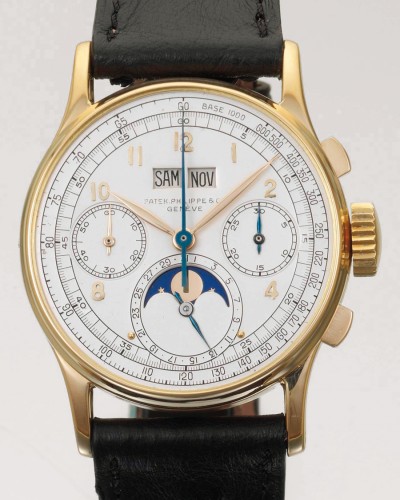
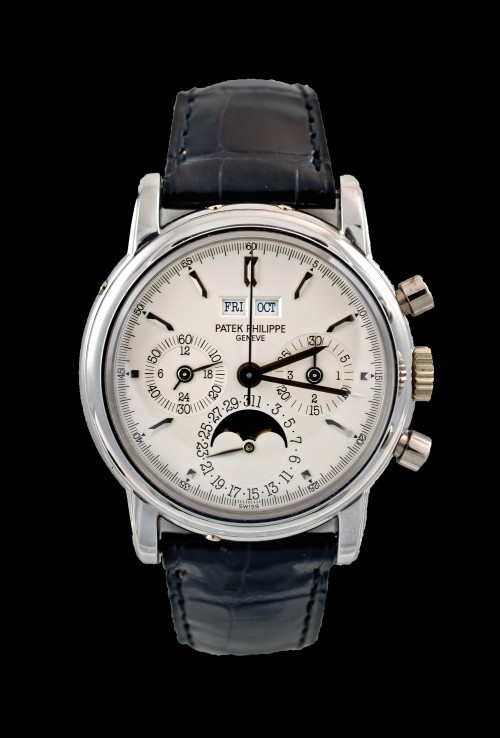
Patek made the first perpetual calendar chronograph with ref. 1518 in 1941 and has been making them continuously since. They have all been column wheel chronographs in the most traditional way with the column wheel covered from direct view. Below is a section taken from a Bonham'sauction describing the history of the Patek QP CH (Quantieme Perpetuel, Chronographe)

Ref 1518 from 1941 until 1952 produced in 281 examples 

(WatchTime Magazine)

Ref 2499 from 1950 until 1985 produced in 349 examples
First model with sapphire crystal


(Antiquorum Auction)

Ref 3970 from 1986 until 2005 produced in approximately 4,000 examples 

(HarrisConor Auction)


Ref 5970 from 2005 until 2010 produced in approximately 2,500 examples 

(minutemachines)

Ref 5270 from 2011

(Patek Philippe)

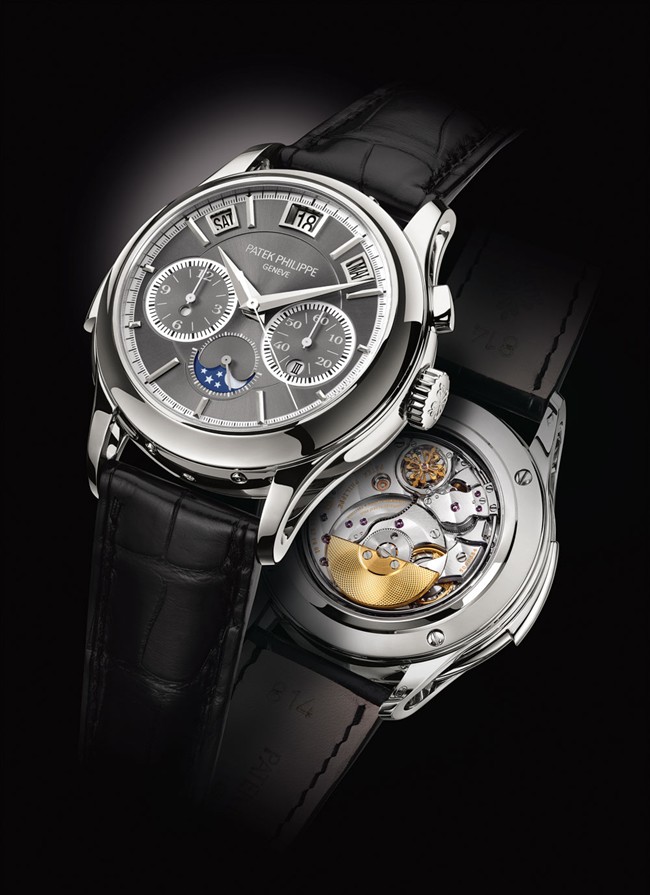
Honorable mention: Patek ref. 5208 (2011) Perpetual Calendar, Chronograph, Minute repeater. Probably the epitome of the brand sans tourbillon. 

Video of a Thierry Stern interview featuring the watch.


Honorable Mention II: 5204 Perpetual Calendar, split seconds chronograph (there are others in this series like the 5004 but these do not belong in the line of perpetual calendar chronographs discussed in this post).