Tuesday, January 29, 2013

Small(ish) Panerais: So close yet a bit far

At SIHH 2013, Panerai released the much critically acclaimed 42mm Radiomir 1940 (PAM00512) which makes this the perfect time for me to talk about the brand from the perspective of a pragmatic watch owner. I still hold that 38 +/– 4 mm is the tolerable size for men's watches, anything smaller than 34 is probably much too feminine and anything over 42 is trying a bit too hard. This is, of course, a general guideline and despite being well in the range, the slight increase in size by Lange in the new Datograph (up to 41 mm from 39 mm) and Patek to its various models (to 40 mm) warns me of an alarming trend across the board: Upsizing.


This dangerous trend is the reason I really appreciate a brand like Panerai (who is often credited to have started this large watch craze) releases something for the pragmatic and aesthetic man such as myself. There are currently two common 40mm models out there: The Luminor Marina and the Luminor 241 Power Reserve. The Marina's dial resembles a white plate placed on a stainless steel counter for me so the 241's hobnail dial and power reserve appeal to me much more. My favorite often overlooked feather of the 241 is its magnifying bubble, which is placed inside the crystal unlike Rolex's protruding cyclops.
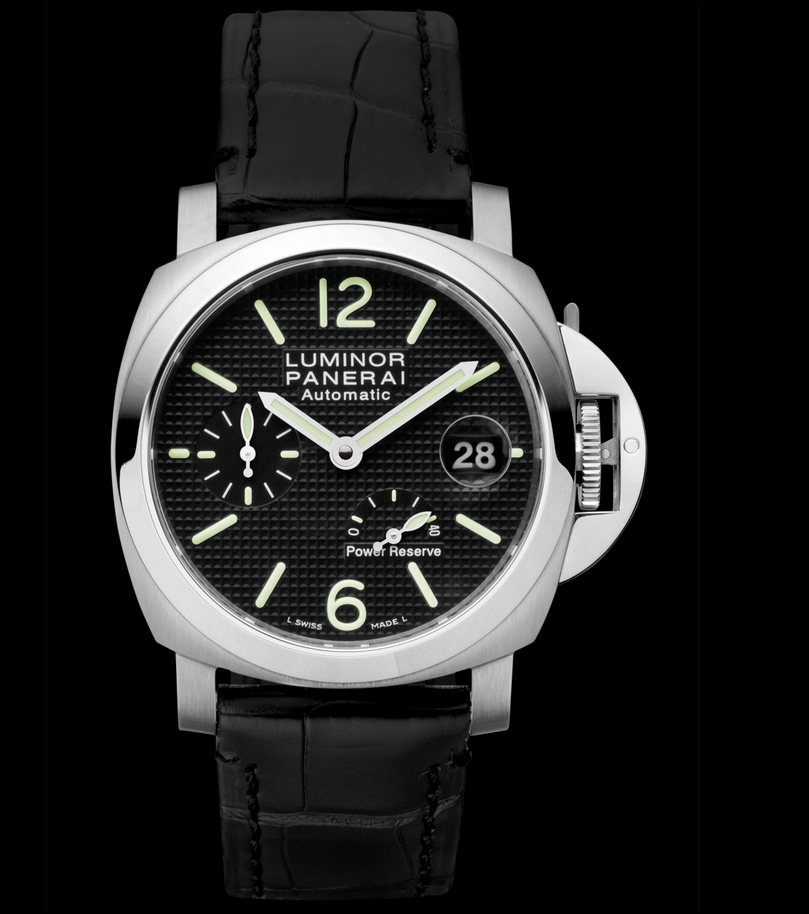

Panerai 241 


The 241 had one problem, it used a modified ETA movement (chronograph-less 7750). The new Radiomir 512 solves this problem and incorporates their pleasant 999 in house caliber with a micrometer adjustment. If you haven't watched Panerai's How It's Made videos, you should do so now to get an appreciation of Panerai's very mechanical approach to watchmaking.

ETA 7750 (Panerai's is much more pleasing to look at and has no chronograph layer)


Panerai's Hand Wound Cal 999 is much prettier (but not free sprung)


Hopefully they'll be out at the dealers for me to try in the metal, but meanwhile, shrink on Panerai!


Saturday, January 26, 2013

Saturday nights with George Washington

Pallet lever, shock protection jewels, set-lever, pallet fork, click spring, and bridge for pallet fork.
Copyright 2013 Horolograph


Friday, January 25, 2013

The importance of COSC, featuring Seagull 1963 Reissue

Over 1 million COSC certificates are issued annually, mostly to Rolex, Omega, and Breitling. While buying my first watch proper, I took chronometer certification very seriously and demanded it. Not surprisingly, with my budget, I ended up with a Breitling. While it was quite accurate, it didn't meet my somewhat haute horologerie expectations. I was then shocked to find that most of what Patek, Vacheron, AP, JLC, and other respected brands produced were in fact not certified. Later I learned that pretty much any well made movement was capable of being adjusted to COSC specifications. 

Below is a sample COSC certificate (courtesy of Dell Deaton):


It basically certified that the movement (not the entire watch) has been tested in the 5 specified positions (mostly at STP of 23 degrees C) and also with dial up at 8 and 38 degrees C. The accuracy requirements over 24 hours are -4/+6 seconds in 24 hours.


So certification must be a good thing right?
Well I'm about to demonstrate how a sub 300 dollar seagull 1963 reissue (with caliber ST-19 based on the swiss Venus cal. 173) has been adjusted by me to better than COSC rates. It might have taken a good 30 minutes to do but the results are (All results measured on a Timegrapher 1000 accurate to 1 second/day, near full wind, rate in seconds/day, amplitude in degrees, and beat error in milliseconds):


Without chronograph running


With chronograph running


Both of the rates average out to a very accurate chronometer grade watch. But we need to remember that this is by no means meant to be a chronometer. The movement is of reasonably high quality but designed to be manufactured at minimum cost rather than maximum precision.

So what's the conclusion? COSC certification is a nice thing to have, but certainly not worth the premium frequently charged. We still have to rely on the integrity of the manufacturer to use quality parts and oils and craftsmanship.

Thursday, January 24, 2013

Studies and photos of Jaeger LeCoultre Caliber 849

If you're a watchmaker, the tech sheets and oiling charts can be found here:

http://www.phfactor.net/wtf/Jaeger%20Le%20Coultre%20Tech%20Sheets/1151_JLC%20849.pdf

Since I'm a movement nerd, naturally, I wanted to know everything about that little caliber residing inside my new Master Ultra thin. After scouring the internet, old catalogs, magazines, and JLC's press archives. I've dug up the following information and photographs. The two full reviews of the 849 movement are done by Walt Odets of Timezone (although actually of the 839 movement) and ei8htohms of PuristS (now PuristSPro).

TimeZone 839 Review
PuristS 849 Review

Please note that the macro photos are my own work and are free to use with proper credit:


Recto


Verso


Basic information:
Released in 1994

123 parts
19 rubies
Four bridge configuration
21,600 vph
1.85mm high
9''' (20.8 mm diameter)
KIF shock protection
Flat hairspring (Nivarox 1)
35 hour power reserve on one barrel
Other features: 2 armed stepped balance wheel, chamfered heat blued and polished screws, Cote de Geneve finish, Master Control 1000 hour QC, polished jewel and screw sinks.


Based on Caliber 839, which is based on caliber 838 (18 jewels, 121 parts, 3 bridge configuration)), which has its roots in the JLC ebauche for VC caliber 1003/AP 2003 (both 18 jewels, 1.64mm high, 18,000 vph, flat hairspring, 9''', 35 hour power reserve).


Used in (current as of SIHH 2013):
JLC Master Ultra Thin (33.4 mm, 4.2 mm high, measured by me to be closer to 34 mm by 6 mm due to domed sapphire, sapphire case back), Master Ultra Thin 38 (38 mm, 6.31 mm thick), Master Ultra Thin Jubilee (180 anniversary, 39 mm, platinum only, solid case back, 4.05 mm thick). Additionally, it is used in a variety of cases based on the first two mentioned, often with high jewelry design.


Below are scans from the 2002/2003 JLC "The Manufacture's Book of Timepieces"


Jaeger LeCoultre Servicing/Overhaul

The new york times published an article three years ago about the servicing cost of watches titled The Watchmakers' Time Bomb. As a collector, it's certainly not news that servicing is a costly but necessary evil. There's really no good answer as to how much servicing should cost, it's anyone's guess. With the increasing number of in-house movements left and right with few shared parts, manufacturers can charge whatever they want for service and get away with it. Standard rates are sometimes published, but parts are always additional. Having just sent in a JLC Master Ultra Thin for service, I've listed the options below (prices are quotes assuming no parts required)

JLC in Le Sentier: 300-800 dollars, includes polish, new gaskets. 120 dollars for refused estimates. Has access to all parts, price range probably reflects replacement of crown which they JLC likes to do to "ensure water resistance."
Time: 7-10 months


Independent #1: 395 dollars, includes polish, new gaskets, new mainspring if needed. Free estimate.
Time: 2 weeks

Independent #2: ~1000 dollars, includes polish, no replacement of gaskets. Free estimate.
Time: ~2 weeks

Independent #3: "We suggest you send it to JLC due to the delicacy of the movement" - At least they're honest

Independent #4: 295 dollars, +50 for polish, new gaskets. Free estimate. "We do not go crazy on the polish like JLC does"
Time: 3 weeks


I think it's a no brainer that I went with the last choice. The independents are all extremely well reputed and dependable, but access to parts can be problematic. Although JLC is the subject of this example, other high end watch brands have a similar problem.


All photos courtesy of JLC

Sunday, November 18, 2012

Journey of Reverso: Part 4.2 (Current Reverso Duo Harmonized MK II)

Most of the information from my post about the older version of this watch stand, the only difference is in the dial and pusher as well as a minor difference in the winding feeling, testing procedure, and new 3 atm water resistance.
Part 4.1 here has all the details about the movement and the watch.


The exact same movement

This is just a brief comparison of the previous and current version of the Reverso Duo in stainless steel on a bracelet. JLC's leather straps are without doubt of the finest quality but are priced at over 400 dollars retail.  So the bracelet is usually a good choice at initial purchase and a fine quality after market strap works very well.


The key differences in the two models are in the dial and the pusher. The movement is the exact same in the two iterations and from what I can tell the bracelets are the same.


 Old dials (courtesy of JLC via PuristSPro)

New dials (note the wave pattern on the white dial is not visible)
(Courtesy of JLC via PuristSPro)

The new white dial has a waved guilloche pattern in the center portion of the dial and a round seconds hand dial while the older version had a diamond guilloche pattern and a rectangular seconds dial. The small textured dots around the perimeter of the dial have been removed. Lettering is still printed instead of applied and personally I prefer the older dial with the finer details.

The black dial has also been simplified, the previous version had a circular wave pattern center dial with a diamond patterned outer dial. The markers were also applied. The new version has a plain center dial and printed markers. I'm not sure which one looks better but given the classical nature of the watch, I personally prefer the older version, especially since I prefer applied to printed markers. Those seeking a simpler watch, especially to be worn on a strap, will likely prefer the older dial with finer details to contrast with the strap while the bracelet may look better with the newer dial, but that's just a matter of personal opinion.


The pusher is probably the biggest source of debate amongst collectors. The old version worked just fine and even came with a tool with which to push the pusher, advancing the hour hand of black dial in one hour increments. The new version is more "user friendly" since it can be pushed like a chronograph pusher. Granted the recessed pusher could be made to be water resistant and is the method still widely used for adjusting functions such as perpetual calendars and moonphases, I neither understand or appreciate the change. It makes the watch less symmetrical and proportional, which is probably the biggest aesthetic selling point of the Reversos (remember the golden ratio of 1:1.6).


Overall, I prefer the older version a lot more, the only advantage I can really give to the mark ii is the 3 atm water resistance and 1000 hour control test, but those are largely meaningless for a watch that was never mean to be worn around water.

Sunday, November 11, 2012

Most expensive watch ever could end up back on the block

This recent Bloomberg article states that Sheikh Al-Thani, the cousin of the Emir of Qatar, owes Sotheby's some 83 million dollars for unpaid auctions. He has now pledged a portion of his collection to repay this debt. The most important piece is the Henry Graves Supercomplication, which sold in 1999 for a groundbreaking 11,002,500 dollars (equivalent to 14,671,799 in 2011 dollars). That was the most expensive price for a watch at the time and should still be considering it was only superseded by a 25 million dollar chunk of diamonds made by Chopard (that may or may not have ever sold). 


The "most expensive watch" today is not really a watch


The watch was made in 1933 for the famous NY banker Henry Graves and houses 24 complications. With the watch potentially in Sotheby's possession, it is likely we will see the ultra complicated pocket watch for sale again in the near future. I don't believe it will fetch that sort of price today, but time will tell.


Patek Caliber 89, slightly more complicated but similar to the Graves watch